Stay In This World
The stories, the culture, the conversations. Every week.
No spam. No third parties. Just Unruly.
On the Wole Soyinka Centre, the concerts arriving on its doorstep, and what infrastructure really means for Nigeria’s creative economy.
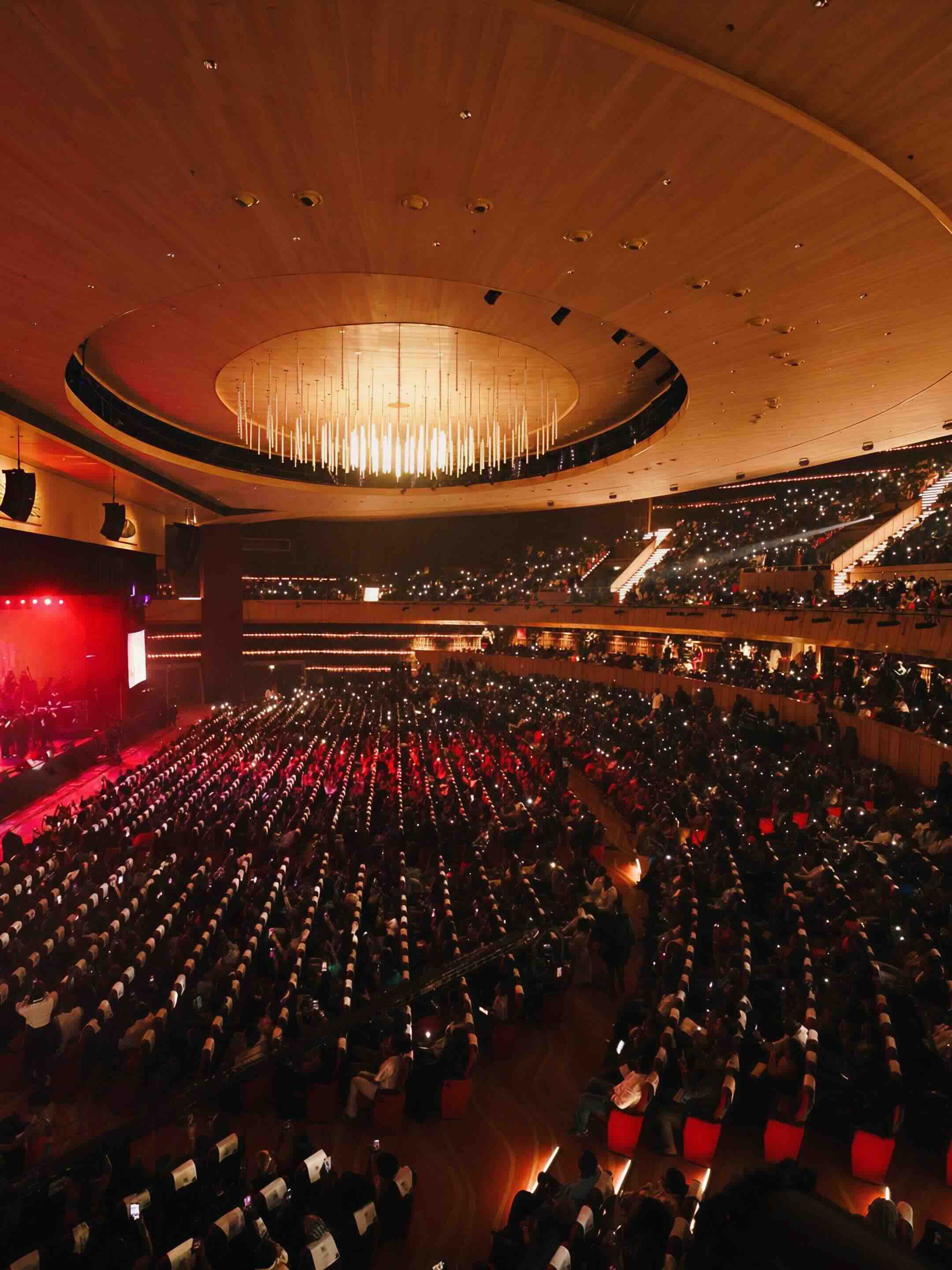
There is a photograph that circulated in the days after Adekunle Gold's orchestra-backed Fuji concert at the Wole Soyinka Centre for Culture and Creative Arts, the newly reopened National Theatre in Iganmu, Surulere. The frame shows a full 3,560-capacity auditorium, every seat taken, chandeliers casting warm light over a room full of people dressed in formal attire. On stage, a full orchestra. The building was packed to its renovated rafters. It was December 26, 2025. That photograph depicts a defining moment in the Nigerian creative industry.
The feeling of opening the ticket links of your favourite international artist announcing a world tour, to find your location missing on the itinerary, is no strange feeling if you are situated anywhere in Africa, and more specifically, Nigeria. However, on June 2, 2026, British Nigerian rapper Dave, Mercury Prize winner, first UK artist to debut three consecutive albums at number one, announced the closing dates of his 'The Boy Who Played the Harp' world tour: Lagos, Nigeria. October 16 and 17 at the Wole Soyinka Centre for Culture and Creative Arts. Presented by Live Nation.
This announcement, six months after Adekunle Gold sold out the same venue, calls for a documentation on what, exactly, was built to make it possible. Adekunle Gold's Fuji concert proved what Dave's tour is now acting on.
The National Theatre was completed in 1976, built during the military regime of General Yakubu Gowon and completed under the administration of Olusegun Obasanjo, its design modeled after the Palace of Culture and Sports in Varna, Bulgaria. One year after its completion, the venue hosted FESTAC '77, a gathering that drew delegations from 56 African and Caribbean nations and installed Lagos at the centre of the pan-African cultural world.
Through successive administrations, the building was underfunded, mismanaged, and left to deteriorate. By the 2010s, the National Theatre had become a monument to institutional neglect rather than a cultural edifice. The turnaround arrived when the Central Bank of Nigeria and the Bankers' Committee committed ₦68 billion to a comprehensive renovation, working alongside the Lagos State Government and the Federal Ministry of Arts, Culture and Creative Economy. Completed in August 2024 and officially recommissioned on Nigeria's 65th Independence Day, the complex was renamed the Wole Soyinka Centre for Culture and Creative Arts, in honour of Africa's first Nobel Laureate in Literature. It now houses world-class performance halls, cinema spaces, exhibition galleries, an African literature library, rehearsal rooms, advanced audiovisual technology, and direct integration with the Lagos Blue Line rail.
The significance of what Lagos has built becomes more relevant when measured against what the rest of the continent holds.
In Accra, what began in 2017 as Mr Eazi's Detty Rave has grown into Detty December, a city-wide cultural season drawing diaspora visitors and international tourists. The infrastructure powering it, however, is largely improvised. At his headline 2025 Detty Rave performance, Mr Eazi paused mid-show to address the Ghana Tourism Authority directly, pledging $2 million of his own money and asking for land to build a proper events venue. A public appeal, from the stage of his own flagship event, for the basic physical conditions that event culture of that scale requires.
The scene in Nairobi mirrors a similar story. The city's performance infrastructure relies predominantly on multi-purpose spaces like the Sarit Expo Centre and the Kenyatta International Convention Centre, neither designed with live performances in mind. Nairobi's most significant new development is the Raila Odinga International Stadium, a 60,000-capacity venue, but by design it is a sports facility. Scale alone cannot substitute for purpose-built cultural infrastructure.
There is a consistent pattern across these cities. The event culture exists. The demand is growing. The infrastructure capable of hosting it at world standard is either absent or adapted from spaces built for something else entirely.
Adekunle Gold did not simply sell out the Wole Soyinka Centre. He became the first artist to headline and sell out the renovated venue, proving that a world-class Nigerian space could generate and serve commercial demand.
The show was constructed as carefully as the argument it made. Gold's performance was backed by a full orchestra, classical arrangements synchronised with his Afrobeats catalogue. Olamide delivered AG's introduction. Fuji legend Adewale Ayuba and gospel singer Yinka Ayefele joined on stage for a closing rendition of "Many People," a sequence that moved from Afrobeats through to Fuji in what felt like an unreal evening. A commentator described it as "the most befitting event to open a venue that holds both the history of our culture and the promise of a great future."
It documents not only the quality of AG's performance, but what is possible when the production context matches the artistic intention. The full orchestra existed because the Wole Soyinka Centre has the stage, the acoustics, and the technical infrastructure to support it. The distinction between art constrained by its environment and art elevated by it is the entire argument for infrastructure across all levels of the Nigerian creative industry.
David Orobosa Omoregie, known as Dave, is the Mercury Prize winner whose latest record references Victoria Island by name, and whose public identity has been shaped by his father's deportation to Nigeria when he was four months old. The Lagos concerts, presented by Live Nation and MASSIVE, close out a global tour that has already moved through Europe, North America, and Australia.
A world tour requires a specific kind of infrastructure: production capacity, formal ticketing systems, a space with standing international credibility. None of that described the National Theatre before 2021. All of it describes the Wole Soyinka Centre today. Every international tour that lands in Lagos reinforces the city's credibility as a destination for the next. Dave will not be the last.
For years, the Lagos concert market was defined by the venues it had to make do with. Eko Hotel's grand ballroom, built for conferences, became a default for mid-to-large scale shows. Landmark Event Centre and Harbour Point offered capacity without purpose-built stages, erected and dismantled for each occasion. Beach events came with inconsistent sound, exposed production rigging, and real risk. The stage at the Nativeland Festival on SoL Beach, Elegushi, collapsed mid-performance during Odumodublvck's set in 2019, triggering a stampede. There was no venue that could be offered as a default, as the O2 is offered in London or Madison Square Garden in New York.
The Wole Soyinka Centre provides a permanent address for events that previously had nowhere adequate to go. Its main bowl seats 3,560 with full orchestral capability, expanding to 5,000 in amphitheatre configuration. A world rap tour and a pan-African technology conference, Moonshot by TechCabal, independently arriving at the same venue within weeks of each other is a data point about what the space has become: the most credible address in Lagos for significant events at any scale.
A single flagship venue, however transformed, does not constitute an ecosystem. The most structural gap remains the mid-tier. Between the Wole Soyinka Centre and the informal spaces where emerging acts build their first audiences, there is almost no reliable infrastructure. No consistent 500 to 1,500-capacity venues, properly equipped and professionally managed, where the development arc of an artist's live career can unfold. In established music markets, that tier, the equivalent of London's KOKO or the Scala, is where commercial viability is tested before the larger rooms are attempted. Without it, artists in Lagos face structural pressure to skip from intimate settings directly to high-capacity shows.
Technical production is a related gap. Sound engineering, lighting design, and stage management determine whether what happens inside a building is experienced as world-class or merely world-class-adjacent. The infrastructure for training these professionals does not yet exist at the scale the market requires. A venue can have state-of-the-art technology in its walls, but that technology requires human expertise to operate.
The case for cultural infrastructure in Nigeria is fiscal, as well as sentimental. Nigeria's music industry generated an estimated ₦901 billion in 2024. Out of that, live performances accounted for between 65 and 74 percent of total artist earnings. Streaming, despite rapid growth, contributed only around 30 percent. The primary generation of revenue still happens in the relationship between a stage, a performer, and the people standing in front of it.
The creative economy contributed $5.6 billion to GDP in 2022. The government's stated target is $100 billion annually by 2030. That gap does not close through streaming alone. A creative economy that cannot stage itself cannot scale itself. The work between those two numbers is physical: venues, licensing frameworks, production pipelines, mid-tier development ecosystems, and the sustained institutional will to treat culture as infrastructure. The Wole Soyinka Centre, ₦68 billion in, is what that will looks like in concrete and steel.
The gaps are real and significant, but the direction is no longer ambiguous. Lagos has built the stage, and the world is witnessing it.