Stay In This World
The stories, the culture, the conversations. Every week.
No spam. No third parties. Just Unruly.
The continent does not have to choose between its future and itself.

In the late 1960s, the Swedish economist Gunnar Myrdal published a book called Asian Drama. In it, he argued that Asia’s economic prospects were essentially hopeless: the continent was too poor, too underdeveloped, too far behind to close the gap with the industrialized world. By the mid-1960s, Asia’s poverty rate stood at 73.6 percent. Its social indicators of development were among the worst anywhere in the world.
At the same moment, Africa’s economic outlook looked considerably brighter. At independence in the 1960s, optimists, including western powers, believed that with its vast natural resources, Africa would develop faster than Asia. Some predicted Africa’s growth potential could reach seven percent annually. In 1960, Nigeria’s GDP per capita was actually 50 percent higher than South Korea’s.
Today, South Korea’s GDP per capita has grown so much more. Asia's poverty rate has fallen from 73.6 percent in 1965 to just 3.2 percent today, according to the Asian Development Bank's 2025 figures. The Asian Drama that Myrdal predicted never came. A different one unfolded entirely.
The story of how Asia went from the world’s poorest continent to one of its most technologically advanced in half a century is one of the most significant development stories in human history. But it’s also something else: proof that the path from poverty to prosperity does not require a group of people to abandon what they are.
Japan articulated this model the most directly. As they began their rapid modernization in the late 19th century, a philosophy emerged that would guide their relationship with western technology and ideas: “Wakon Yosai”, which translates roughly as “Japanese spirit, western technologies.” This was a deliberate framework, to take what the west had built in terms of industrial and technological capability, absorb it, and apply it through a distinctly Japanese sensibility. Modernization would not mean becoming western. Rather, it would mean become more Japanese, with better tools.
South Korea followed a different but parallel path. After the devastation of the Korea War left the country, in the words of its time, in “too poor a condition economically to benefit from further aid”, Korea built an industrial infrastructure through coordinated economic policy, export-led growth, and massive investment in education. Growth rates of GDP and GDP per capita in Asia have been stunning and far higher than elsewhere in the world. Rising investments and saving rates combined with the spread of education were the underlying factors.
But what South Korea also did, throughout its extraordinary economic transformation, was insist on the primacy of its cultural life. Concepts like “nunchi”, a subtle art of situational awareness and reading unspoken social cues, “jeong”, a form of deep relational attachment, and “pungsu”, a traditional philosophy of environmental harmony, were not abandoned in the pursuit of growth. They were preserved alongside it. South Korea is now a fascinating example of the harmonious coexistence of tradition and modernity. Unlike many western societies, Korea has managed to preserve its cultural heritage while becoming one of the world’s most technologically advanced nations. The Hallyu wave that has since reshaped global culture, through film, music, food, and fashion, was not a product of Korea becoming more western. It was a product of Korea becoming more fully itself.
The lesson the Asian story offers is not simply that economic growth is possible for non-western countries. It is that economic growth does not require cultural substitution. The version of progress that insists you must become more like the west in order to advance is not neutral observation about development. It is an ideological position, and the one that evidence of the last half century does not support.

While compelling, the Asian model is also worth examining honestly before applying it wholesale to a different continent in a different era.
South Korea’s economic transformation did not happen gently. The rapid industrialization of the 1960s and 70s occurred under authoritarian rule, with significant suppression of labour rights, political dissent, and civil freedoms. The cultural identity that survived Korea’s modernization was not passively maintained. It was contested, fought over, and in some periods actively suppressed by the same state that was driving economic growth. The version of Korean culture that eventually projected globally through the Hallyu wave was the product of a long and difficult internal negotiation, not a smooth parallel track running alongside development.
Japan’s wakon yosai philosophy, was similarly more fraught in practice than it sounds in retrospect. The rapid westernization of the Meiji era produced deep cultural anxiety among Japanese intellectuals and elites, who spent decades grappling with what it meant to modernize without losing themselves. The cultural confidence Japan now projects globally was not a given. It was constructed, sometimes painfully, over generations.
The structural starting points also matter. At independence, South Korea and Taiwan had significantly higher rates of primary education than most of Sub-Saharan Africa. Asia’s development in the postwar period benefitted from specific Cold War geopolitics: US investment, strategic military partnerships, and preferential trade arrangements that reflected America’s interest in containing the spread of communism in the region. Africa did not receive equivalent structural support. The conditions were different enough that drawing a direct lesson without acknowledging the difference risks oversimplification.
And within Africa itself, the cultural question is more complex than it first appears. The continent has 54 countries, over 3000 ethnic groups, and more than 2000 languages. When we speak of building African advancement on African cultural foundations, the question of which African culture, whose values, whose languages, whose ways of organizing community becomes the foundation, is not abstract. It is political, and it has produced real tension across the continent’s postcolonial history.
The numbers tell a story that often goes undertold. Africa's mobile technology sector generated $220 billion in economic value in 2024, representing 7.7 percent of the continent's GDP. Over 709 million registered mobile money accounts exist in Sub-Saharan Africa. The continent's fintech market recorded a 38% compound annual growth rate between 2021 and 2025. Nigeria's fintech sector alone contributed 19 percent to the country's GDP in 2024, with over 76 percent of Nigerian fintech startups already profitable.
M-Pesa, Kenya's mobile money platform, solved a financial inclusion problem that western banking infrastructure had failed to solve for decades. It did so not by copying a western model but by building something new from the specific conditions of the Kenyan context. By 2022, M-Pesa had helped lift approximately 194,000 Kenyan households out of poverty. Africa's GDP is projected to grow at 3.8% in 2024, the second-highest growth rate globally after Asia, and the World Bank forecasts 4% growth for 2025 to 2026.
A November 2025 joint report from the OECD and the African Union Commission found that Africa could more than double its economic output by 2040 if countries scale up annual infrastructure investment to $155 billion. If the African Continental Free Trade Area, the largest free trade zone in the world by number of participating countries, reaches its potential, it could add $450 billion to Africa's income by 2035 and boost wages for women in particular by 10.5%.
None of this is inevitable. It requires investment, governance, infrastructure, and institutional seriousness. And it requires honesty about what the numbers do not yet capture. Africa's innovation story has a distribution problem. The fintech revolution and the mobile money gains are concentrated in a handful of cities and countries. The benefits have not reached the majority of Africans equally.
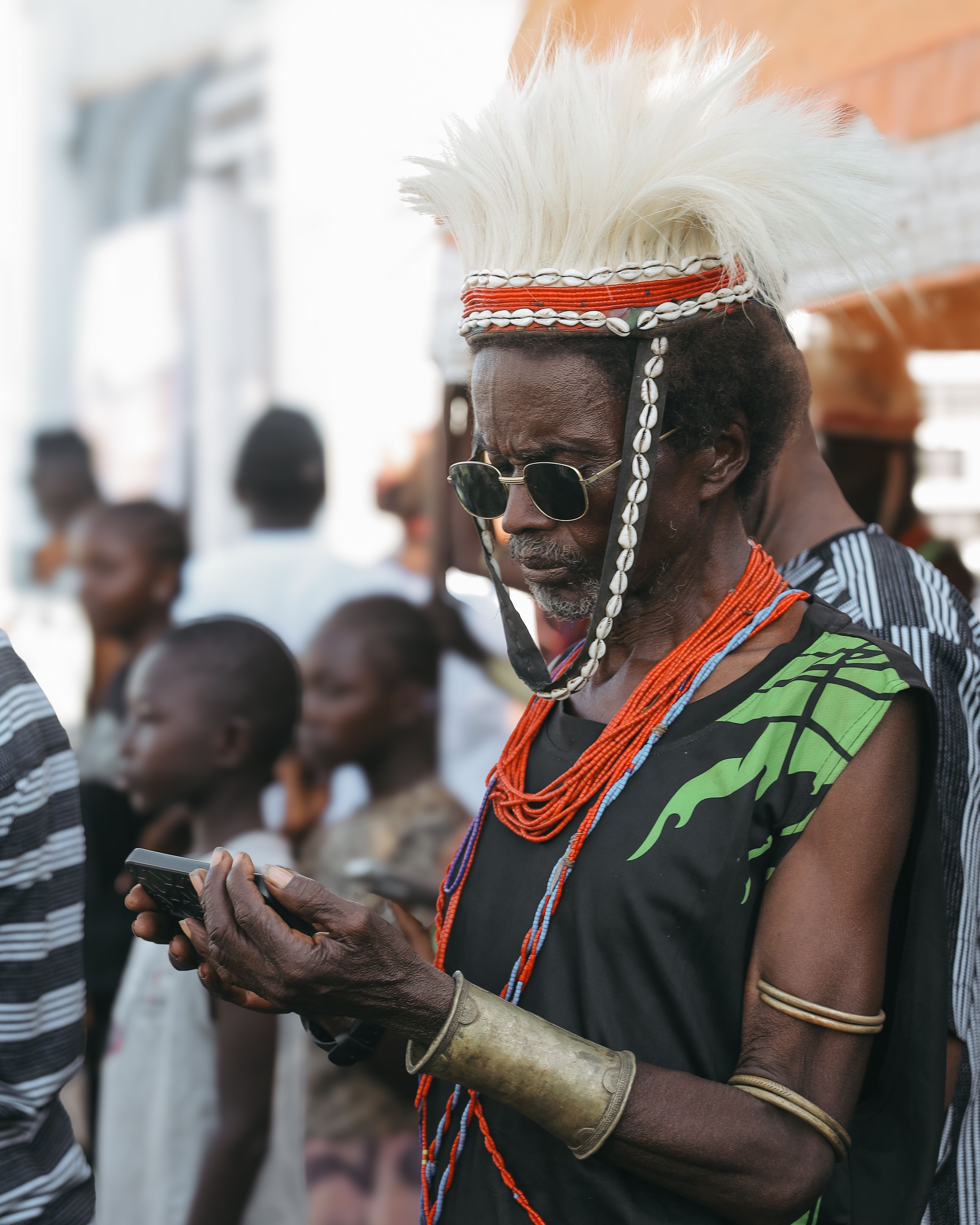
What Asia demonstrates, and what Africa's own creative and intellectual output is increasingly demonstrating, is that culture is not an obstacle to development. It is the foundation on which sustainable development is built.
Japan's gaming industry, South Korea's film and music industries, India's software sector: each of these global forces is rooted in something specific and local. The anime aesthetic is not universal. It is Japanese. The specific emotional register of a Korean drama is not interchangeable with an American one. The Indian software engineer's training comes from a particular educational and cultural context. The global reach of these industries is inseparable from their cultural specificity. They did not travel by becoming more generic. They travelled by becoming more precisely themselves.
The same logic is at work in Africa's most globally successful cultural exports. Afrobeats did not achieve global dominance by sounding more like American pop. It achieved it by sounding more like Nigeria, more like the specific sonic environments from which it emerged. The fashion designers setting global trends are not referencing a neutral international aesthetic. They are drawing from Yoruba lineage, West African textile traditions, and the specific visual languages of the continent. The most compelling African films winning at international festivals are not imitating Hollywood. They are documenting specific African experiences with the confidence that specificity is the currency of genuine storytelling.
The idea that Africa must choose between its culture and its future is not a description of reality. It is a failure of imagination, often absorbed from systems built to benefit from that particular confusion. Asia did not choose. Africa does not have to.
Becoming more advanced does not mean becoming less African. It means building infrastructure that can carry African life forward on African terms: healthcare systems designed for African disease burdens and climates, urban planning that accounts for African community structures and weather patterns, educational systems that teach African children in their own languages and from their own histories, technology built to solve African problems by people who understand them from the inside.
Africa is not at the beginning of this story. It is in the middle of it. The mobile money revolution happened here, not in Silicon Valley. The creative industries making the most compelling work in the world right now are drawing from this continent. The continent with the youngest population in the world, projected to have 26 percent of the global population by 2050, is not running out of time.
The future of Africa does not have to look like a westernized version of its former self. It does not have to look like anything that has come before, from anywhere. That is both the difficulty and the extraordinary possibility of this moment: the future is genuinely open, and there is a continent of two billion people, with its cultures intact, its creativity documented, and its innovation accelerating, to build it.