Stay In This World
The stories, the culture, the conversations. Every week.
No spam. No third parties. Just Unruly.
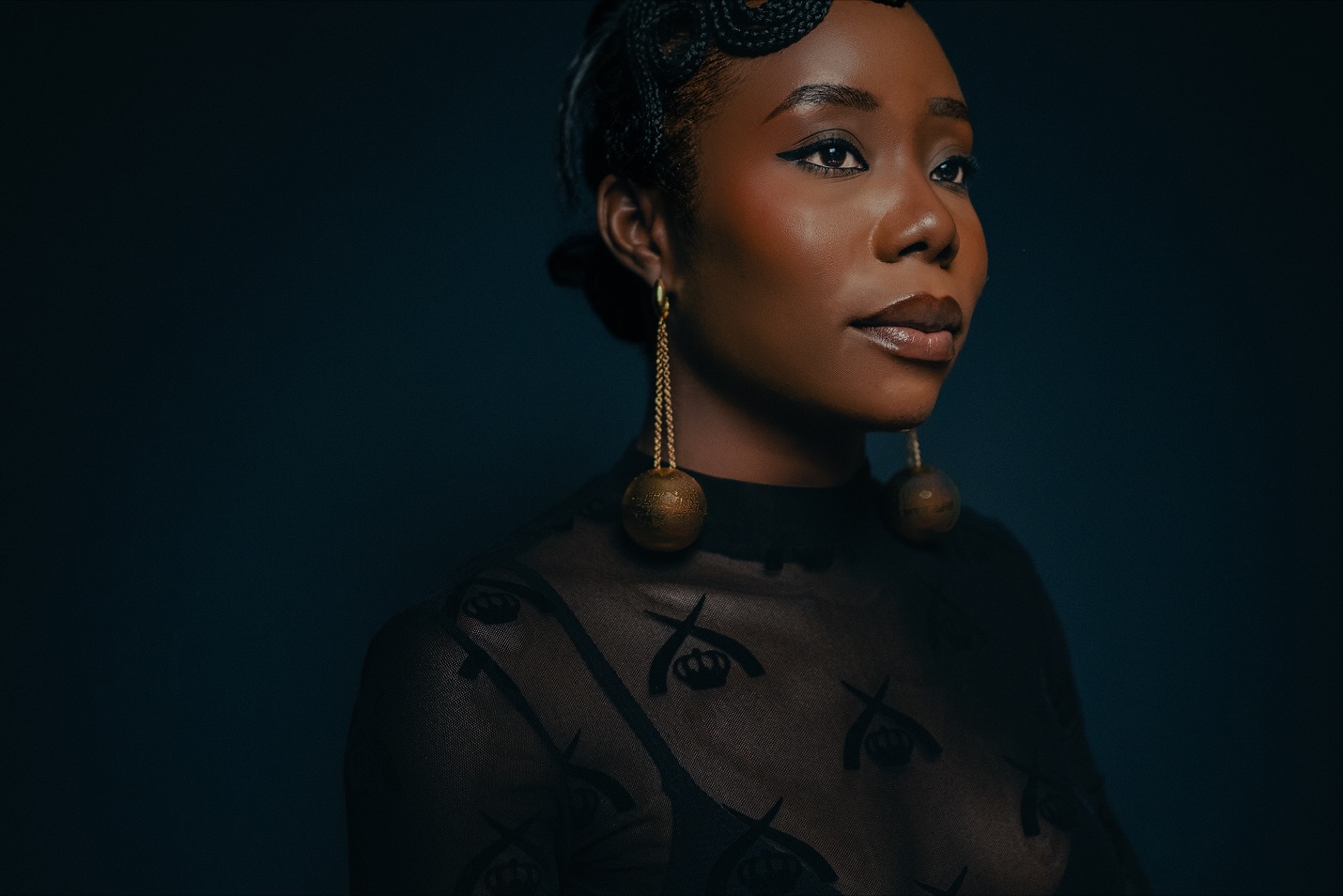
Kusheda Mensah on Ghanaian heritage, the seven years a pouf took, and what motherhood taught her about design.
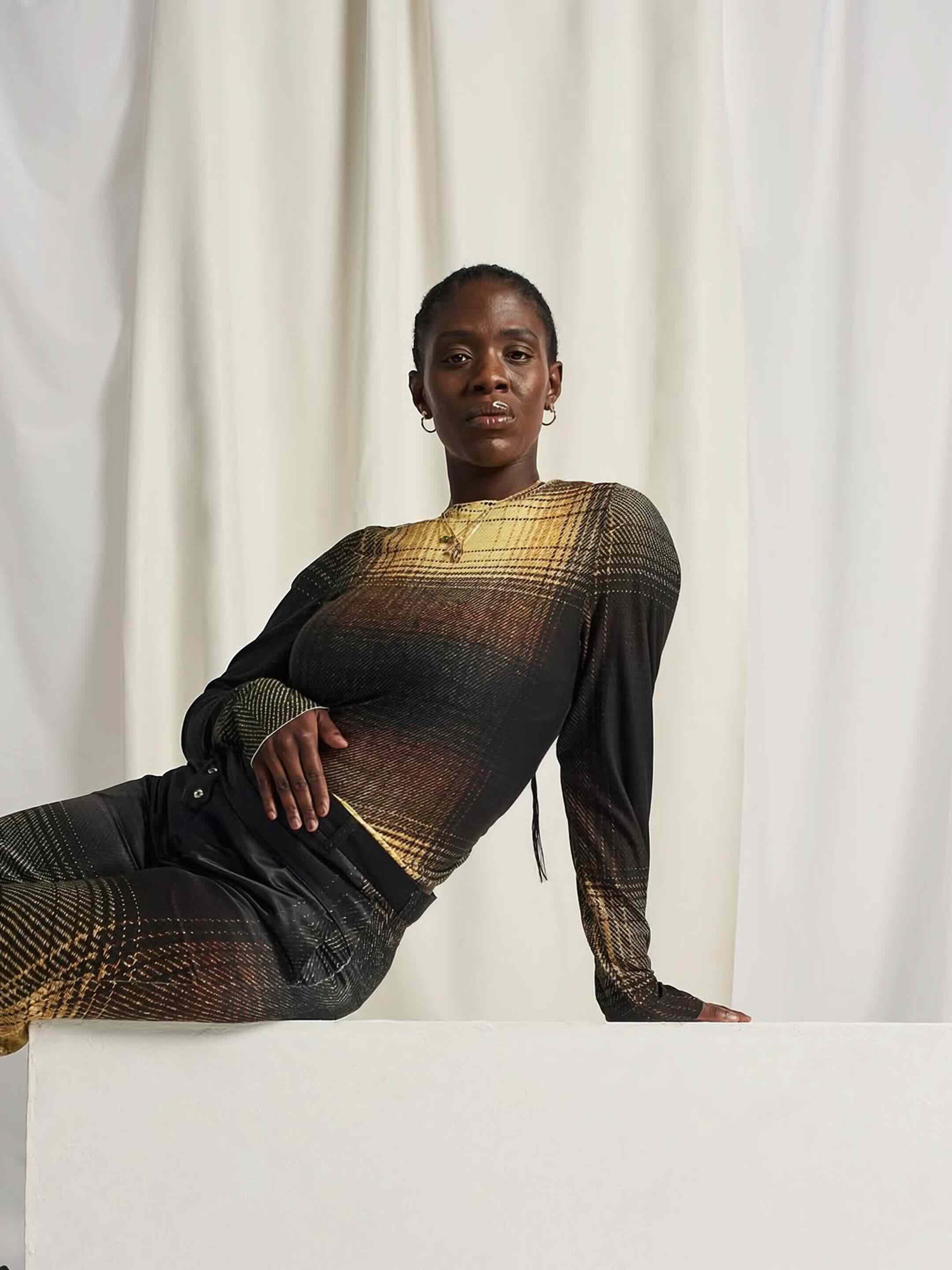
There is a semi-circular pouf that has lived in Kusheda Mensah's home for years. Her children use it as a seesaw and a step stool. She uses it as a desk chair. It moves around the room, gets repurposed, adapts. It is, in that sense, a precise expression of everything she believes design should do: sit quietly in the middle of life and make connection easier.
Mensah is a British-born Ghanaian designer based in London, founder of Modular by Mensah, and one of the more distinctive voices in British furniture and social design. She came to furniture by way of textiles, a pivot that was not really a pivot at all, pivoting her attention from fabrics to furniture after encountering the work of Verner Panton and Ettore Sottsass at university, and showing at SaloneSatellite in Milan just one year later. The throughline between surface design and modular furniture has always been the same question: how does an object shape the way people relate to one another?
Over the course of her career, the question has remained the same. The difference now, is how deeply she is now willing to go seeking for the answer.
I asked Kusheda about her decision to move from textiles to furniture, and if felt like a pivot, and her answer is clear. She said "I wouldn't describe it as a pivot. Textiles came very naturally to me because, growing up in Ghana as a young girl and then brought up in London, I was surrounded by rich textile traditions, symbols, weaving, and material culture. Those influences have always shaped how I think about design."
The connection between the two disciplines is not just aesthetic. It is philosophical. When she began exploring modular furniture, what drew her to it was the same thing that had drawn her to textiles: the potential to bring people together. The materials needed to be tactile, inviting, emotionally engaging.
"Looking back, textiles and furniture feel like different expressions of the same instinct: using design to foster connection and shape how people relate to one another.”
Ghanaian textile culture gave her something specific that still runs underneath the furniture work, even where there is no pattern or print to carry it visibly. Garments in Ghana are embedded with symbols, and there are certain expectations and codes for what is worn at occasions. It is a nonverbal way of speaking with one another. Adinkra symbols taught her that design can communicate meaning without words. "While my furniture doesn't always carry printed patterns, that understanding still informs how I work." For her 2024 exhibition at Harewood House, a site with a complex historical connection to Africa and the transatlantic slave trade, she created furniture that loosely referenced Adinkra forms. These forms, structure, and cultural memory are doing the work for her that surface patterns does elsewhere.
The Palma Pouf, produced in collaboration with Swedish furniture brand Hem, is the reimagining of a hand motif Mensah first developed for her Mutual collection and showed in Milan in 2018. It didn’t reach a mass market until 2025. That is seven years between the idea and its wider landing.
She funded and produced the original design herself, carrying significant financial risk. She was marketing the piece independently during COVID, simultaneously spending time in hospital with a premature, unwell baby. More children followed. A design practice, a family, a body of work built in the spaces between caregiving and survival.
"The seven years weren't just about developing a product," she says. "They were about navigating life." She never stopped believing in the idea. "There were moments when it would have been easier to move on, but I trusted my instincts and kept going." The Palma Pouf reaching a wider audience is, for her, evidence that persistence matters, and that the longest journeys are often the ones that shape you the most.
In 2024, Mensah returned to her studio after four years away, time she had taken deliberately to focus on motherhood. The return was not a simple resumption of what she had left. It was something different.
"Taking four years away from the studio to focus on motherhood changed my relationship with my practice completely. I didn't want to keep up with the constant pace of the industry or feel pressured to produce work simply for the sake of producing it."
Having children made her more conscious of the resources she had, financially, physically, emotionally, and it meant every project needed to feel genuinely meaningful rather than simply necessary.
What the pause produced was a reckoning with pace and purpose. "What changed most was realizing that I needed to give myself time, time to develop ideas properly and to sit with uncertainty." The goals she had set for herself up to that point had largely been met. Motherhood created the space to ask what came next, and to answer that question honestly rather than habitually. "Not every stage of a creative practice needs to be driven by clear outcomes. Sometimes growth comes from allowing yourself the space to explore, reflect, and redefine your ambitions."
The ideas that now sit at the centre of her work, care, community, patience, connection, are not coincidentally the same ideas that raising children deepened in her. The practice and the life have become harder to separate.
The next chapter of Mensah's practice is turning toward an archive that does not yet fully exist. Much of her current thinking is centred on Black design history and the gaps within its documentation. "When I talk about a lack of archive, I don't mean that the work doesn't exist. I mean that it isn't always as readily accessible or connected through a clear historical narrative in the way that, for example, Italian design is. And often those design references are African."
She is going back to her own heritage, her own textiles, her own design language, asking what it means and how to communicate it. The question of what gets preserved, what gets celebrated, and what gets overlooked is one she is now asking formally rather than instinctively.
"I'm interested in how design can carry cultural memory and lived experience, and what it means to contribute to that ongoing conversation through my own work."
It is, in the end, the same instinct she has always had, translated into its next form. The archive Mensah is building toward is not separate from the furniture she has been making. It is another way of asking how design holds meaning, and who gets to decide which meaning gets held.