Stay In This World
The stories, the culture, the conversations. Every week.
No spam. No third parties. Just Unruly.
On memory, material, and the spaces where sensation and heritage meet
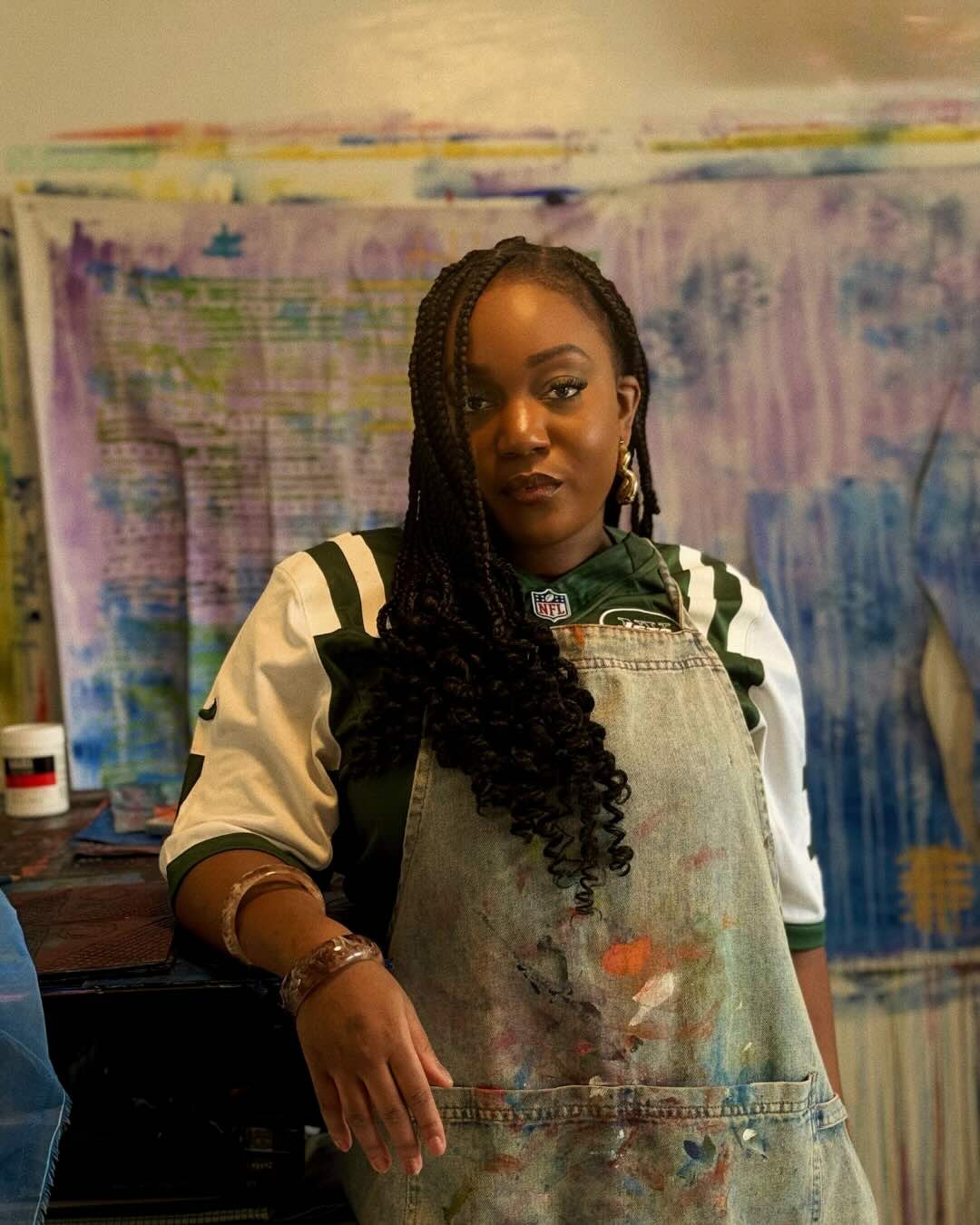
Before Nola Ayoola picks up a material, something has already begun. There is a feeling she cannot immediately name, something that lingers at the edge of language. It might come from a sound, a memory, a shift in light, or the residue of a dream. Whatever its origin, it sits with her before it becomes anything visible.
"It feels like moving through a space that is both familiar and uncertain,"
That in-between state, neither fully resolved nor fully abstract, is where her work begins. The hybrid-scapes she builds, abstract environments that merge the dreamlike with the tactile, are her attempt to give form to what arrives first as sensation. It is a process of translation without a fixed destination. She might sketch or write in these early stages, or handle materials without any clear outcome in mind. The purpose, as she describes it, is not to define but to enter into dialogue. The work is already in motion before the first physical mark is made.
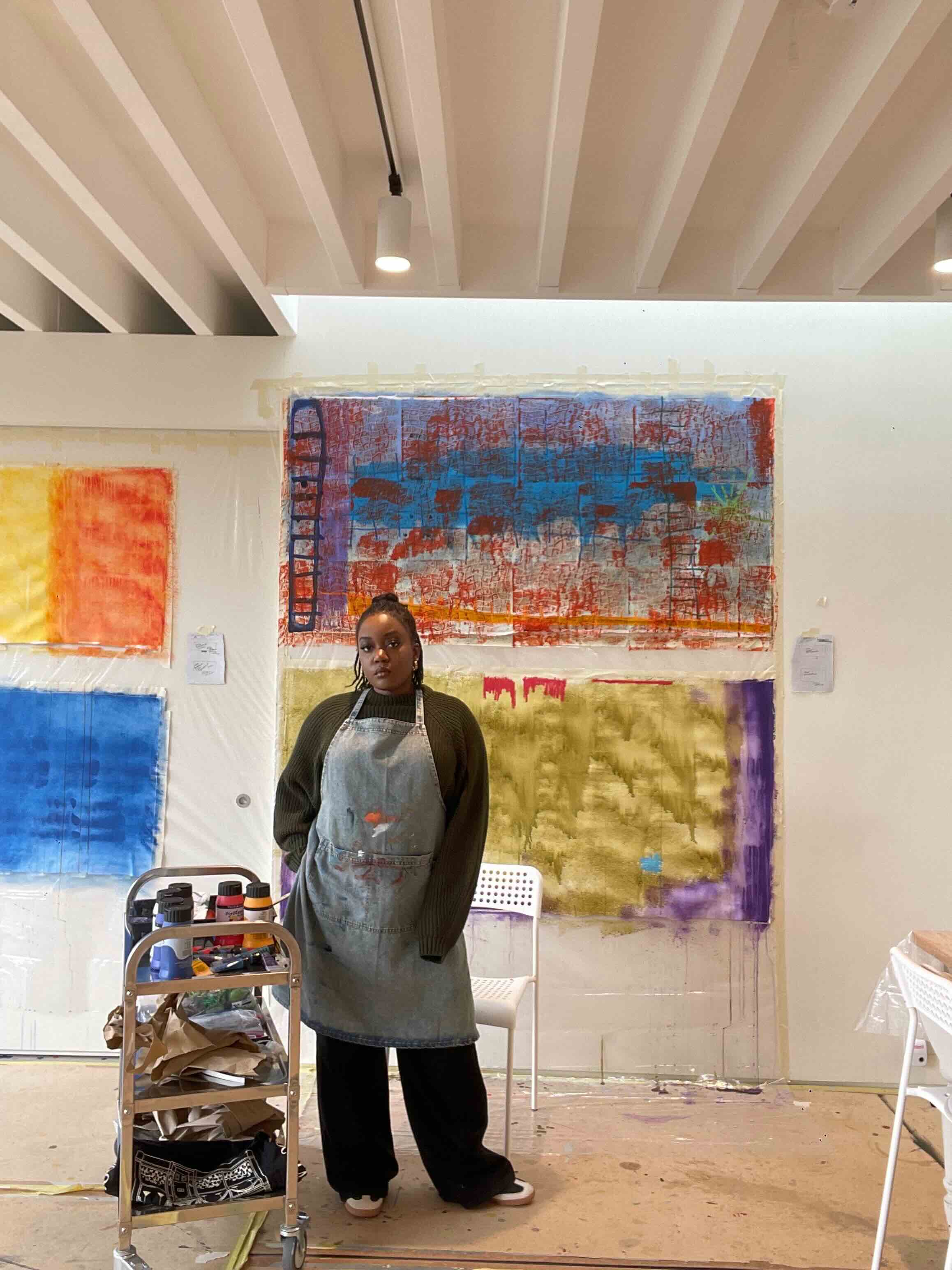
Ayoola's practice is anchored in questions of identity, migration, and belonging, but she resists the idea that art should resolve these questions. Her work creates space for their complexity rather than collapsing it into an answer.
She describes her practice as a visual journal, something simultaneously personal and archival. On one level it traces her own memory, heritage, and lived experience. On another, it reaches outward, into the stories of others who have navigated leaving, arriving, and existing between places. "I often tell the stories and lived experiences of others," she says, "examining how migration shapes identity, belonging, and cultural memory."
The work does not settle these questions. It holds them. And in holding them, it invites viewers to bring their own histories and experiences into contact with what they are looking at. The encounter between artwork and audience is, for Ayoola, itself part of the work. "Stories are held, witnessed, and transformed," she says, describing what happens in that exchange. The work exists in that dialogue rather than prior to it.
Ayoola moves across weaving, collage, painting, and etching, and the choice of medium is never arbitrary. Each material carries its own logic, its own form of resistance, and certain feelings seem to know which one they belong to. Weaving calls for slowness. Its repetition is deliberate, meditative, a way of processing and holding time. Collage operates differently: the cutting, the disruption, the reassembling, these gestures suit states that feel fragmented or urgent, where confronting and restructuring an experience is the work itself. Painting allows something more fluid, a direct translation of emotion through gesture, colour, and movement.
"I think of materials as having their own language and resistance,"
she says. The decision about medium is not separate from the idea being explored. It becomes part of how a feeling is understood, translated, and ultimately experienced by whoever encounters the finished work.
The physical act of making is inseparable from the emotional and conceptual process. When the work moves into form, it becomes a way of grounding what was previously internal. Material gives weight to something that was otherwise only felt.
.jpeg)
Central to Ayoola's practice is an impulse to deconstruct, to take things apart before considering how they might be reassembled. She describes this as both physical and conceptual. Physically, it might mean unweaving, cutting into surfaces, or dismantling forms to understand their texture and possibilities. Conceptually, it means breaking down ideas, memories, and emotional states, examining them from different angles.
She is direct about what the reconstruction asks of her. "It is definitely often difficult to put things back together, and that tension is so central to the process." But the difficulty is generative. The act of reassembly is not about returning something to its original state. It is about reconfiguring it, allowing what came before to carry traces into something new.
That tension between difficulty and possibility is where new forms and meanings emerge. The work carries the pressure of what it went through to become itself.
%20Series%5D(2025).jpeg)
The word she chose for her Cape Town Art Fair presentation says something precise about how she understands memory. Reverberations speaks to how experience lingers, how emotions and encounters echo across time rather than existing as singular contained moments.
For Ayoola, memory is not something distant or archival, retrieved from the past when needed. It is something actively encountered in the present, felt again through habitual gestures, familiar spaces, and sustained attention. "I was thinking about memory not as something we retrieve from the past," she says, "but as something we actively encounter and re-experience in the present."
The works from this presentation function as thresholds. Places where sensation, memory, and presence can coexist without being resolved. They do not close. They hold space for what continues to echo, inviting anyone who encounters them to locate their own experiences within those layered structures.
In this sense, reverberation is not just a title. It is a description of her method: the layering, dismantling, and reassembling that characterizes how she works. And it carries a specifically Yoruba understanding of knowledge, reimagined here as something passed through gesture and repetition rather than through explicit transmission.

Ayoola's work draws from Yoruba heritage, folklore, and mythology, but it does not illustrate them. The inheritance lives in the techniques she uses, in the tactile, repetitive, embodied nature of her process, connecting directly to traditions of craftsmanship and ways of learning that come through sustained physical engagement.
When she draws from Yoruba folklore and mythology, she approaches them as living structures rather than fixed narratives. She is drawn to their atmospheres, their emotional weight, and their relationship to identity. These qualities are translated into abstract form through colour, layering, and fragmentation. The result is work that evokes rather than depicts.
"Heritage is not just reference," she says. "It is method, something I move through physically as I work." Drawing from that inheritance is not a stable or settled act. It is an evolving dialogue between past and present, tradition and transformation. The heritage does not sit outside the work, available to be illustrated. It is inside the process itself, shaping how she moves and what she makes.
Her hybrid-scapes are the output of that ongoing negotiation: landscapes built from the inside out, where memory, material, and ancestry arrive at something that could not have been planned in advance, only discovered in the making.