Stay In This World
The stories, the culture, the conversations. Every week.
No spam. No third parties. Just Unruly.
On a name nearly lost, a label he chose to keep, and turning grief into something wearable.
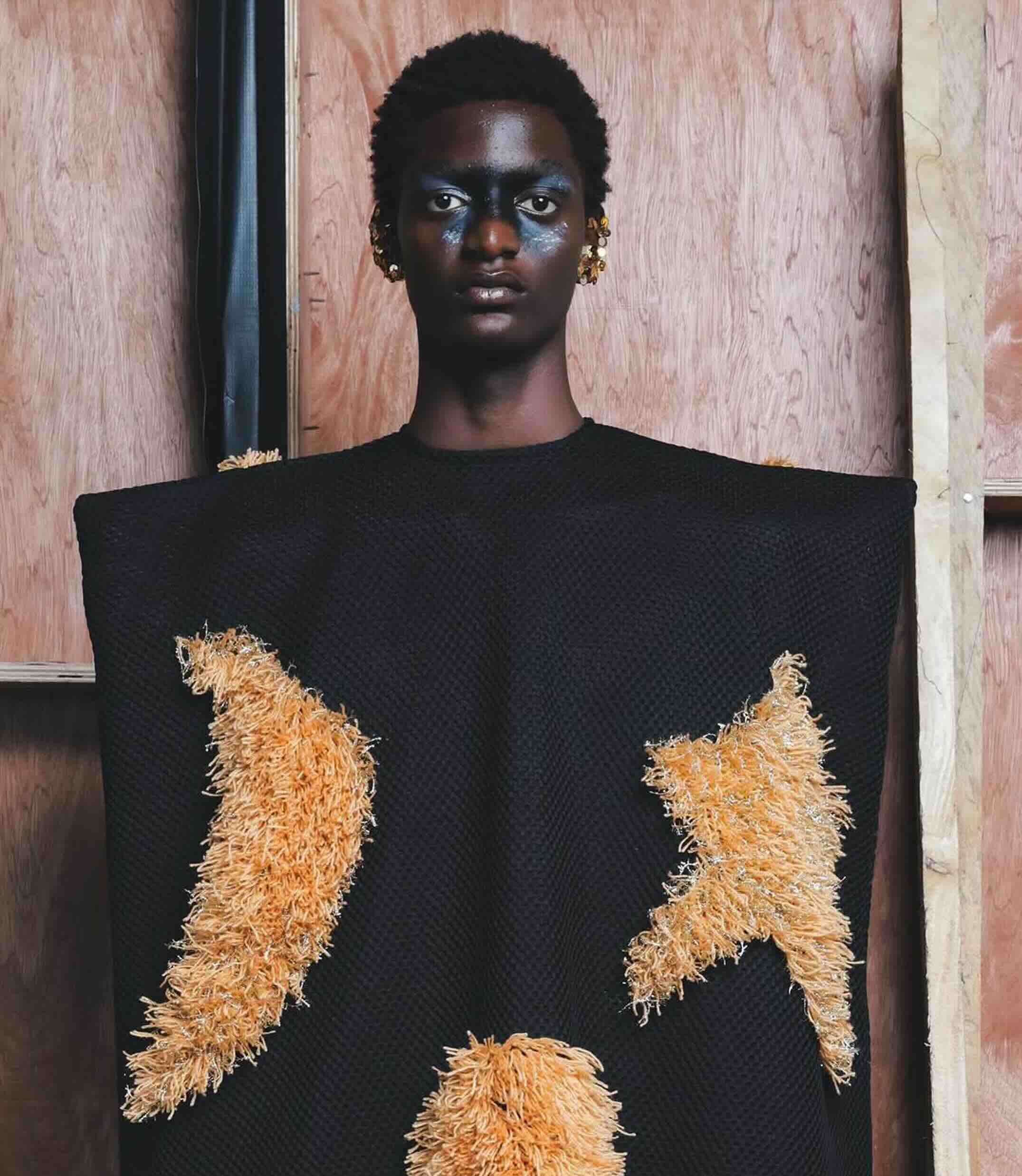
Peter Oshobor has stopped looking for his identity. For most of the years he's spent building Oshobor, the work was an act of discovery, figuring out a design language, a voice, a reason the brand existed beyond the fact that he needed it to. That period is over, by his own account. "I'm at a place of understanding at the moment," he says. "I completely understand it now, to the point where it's not like when I was starting initially, where I'm still trying to get my story together." He knows now. What comes with knowing, he says, is not contentment but appetite. "Because I know and I'm aware now, I want more than what I already have."
That hunger is shaping the collection he's currently building, A Different Kind of Human, a body of work he first attempted years ago, before the brand had the audience or the grounding to carry it properly. He's returning to it now with the kind of clarity that wasn't available to him then, work built explicitly with international platforms in mind, the LVMH Prize among them. It is, in a sense, the same idea revisited by a different version of himself, one who finally trusts what he's building enough to ask more of it. That trust did not arrive easily, and very little of what built it looked like progress at the time.
Oshobor is his family name, and for a long time, it was one his generation had quietly agreed to retire. "All my father's siblings stopped bearing the name in the struggle," he says. It had been passed down for generations, but his father's generation had largely let it go, and Peter and his siblings assumed they would too. "We felt like it was too old. It was archaic. We didn't need to continue the name."
What changed his mind was a fashion writer's offhand observation at a competition in 2021. Peter had been quiet through the critique session, still searching for an identity distinct enough to stand on. "He was like, I'm trying so hard to be international when I can be indigenous," Peter remembers. "Why are you trying so hard to be international? You can be an indigenous brand, and the international people will look for you." He didn't sleep that night. By morning, he had a name, a story, and an identity fully formed. "I just told myself, if Gucci and the other brands had abandoned their family names, they wouldn't be what they are today. I know that we are the only ones bearing this name. I can't just let a name like that die."
The red came later, but from the same root. Through his first four collections, his father drove him to every shoot, every lookbook, every editorial, present at almost everything before the brand had anything to show for itself. When Peter went looking for a story to tell through color, the answer was already standing next to him.
"This name is not supposed to die," he says. "I wanted to express how much love and support my father has shown me. And the thing that binds me to my father, and binds my father to his father, and his father before him, is our bloodline. The blood is red."
It helped, he adds, that red is also the color of his home state. Lineage and geography, pointing at the same shade. What looks, from the outside, like a strong brand identity is really something closer to an act of preservation. A name nearly let go of, picked back up. A color chosen because it was already the truest thing he had to say.
The masquerade label was never something Peter chose. It found him, the way unwanted nicknames often do, attached itself before he had any say in the matter.
It started with a ghillie suit, the first standout piece from an early collection. He hated the initial shoot. "I told my friend I wasn't going to release the collection. It wasn't beautiful," he says. A friend convinced him to reshoot it, promising to buy the piece himself if Peter followed through. He did, and the second set of photos changed his mind entirely. He used the look to apply to Lagos Fashion Week, and got in.
What he hadn't anticipated was how people would describe what they saw. The model's face had been covered in a way that, to a wider audience, read unmistakably as masquerade. "I just kept seeing everywhere, masquerade designer, masquerade designer," he says. "I was like, what is this? What's going on?" His first instinct was retreat. He didn't want the comparison, partly because of an old wound, mockery he'd absorbed years earlier running a modeling agency as a university student, when people accused him of "playing dress up." He'd spent years since then being careful about presentation, precisely so no one could call his work tacky again. The masquerade label felt, at first, like that old judgment finding a new way in.
Instead of running from it, he kept it. "I told myself, when you started this brand, you told yourself you wanted an identity. You wanted people to know you for something. They know you for it. Why not just take it." For a while, masquerade designer sat directly in his bio. He wore the label until it had done its work, until the association had carried him somewhere a vaguer identity couldn't have. Eventually, the label outlived its usefulness, and he let it go just as deliberately as he'd once put it on. "I think the name has outlived itself," he says. "I'm not going to define myself by this." Nobody calls him that anymore. He suspects, simply, that people finally understood what he'd actually been doing.
Grief, for Peter, has never been something to set aside until the work is finished. More often, it has been the thing that produced the work in the first place.
Fractured came out of losing his only employee at the time, a period he describes plainly as one of the lowest of his life. He had no machines, no equipment, barely any of the infrastructure a collection requires, and he built one anyway, almost entirely by hand.
"If losing my work at the time didn't break me, if not having access to machines and equipment didn't break me, and I still went ahead to make a collection," he says, "then it meant that there was nothing that was going to stop me."
The collection wasn't proof of talent so much as proof of endurance, evidence, made physical, that he could survive something and still produce.
Motunrayo carried a different kind of weight, the memory of a friend who had wanted to be a pageant queen like Agbani Darego, but lived, in his words, with restriction. He was careful about how he chose to honor her. "Nobody just wants to wear death written on their body," he says, rejecting the instinct toward grief made literal and heavy. What he built instead leaned toward celebration, a short fashion film with five women wearing sashes bearing her best qualities, charismatic, well-mannered, alongside titles that played with language the way a real pageant might, Miss This, Miss That, one of them reading Miscarriage, a quiet, specific echo of what was actually lost. "I wanted to make it very beautiful," he says, "and not paint it in a way that feels like regret." He knew her well enough to dress her as she might have dressed herself, had things gone differently. People didn't need to know the full story to feel the shape of it. "They like that I was able to explore that in a way that felt light."
In both collections, what could have stayed private, a loss with no outlet beyond grief itself, became something other people could choose to wear. Not as a costume of someone else's pain, but as a kind of continuation. Clothing that kept moving once the moment that inspired it could not. The same instinct that kept a name alive and turned grief into something wearable shows up, less visibly, in how Peter approaches fabric itself.
The economics of running a slow fashion brand in Nigeria right now are unforgiving. Fabric costs have more than doubled in two years, and even designers who set out with discipline find themselves back in the market more often than they'd planned. "I started this collection telling myself I was not going to buy any new fabric," Peter says. "But I find myself still going, because we have to do what we have to do." What keeps the pressure from becoming a constant emergency is a practice he's never spoken about publicly before, pieces from past collections, quietly recycled, upcycled, repeated, sometimes for years, without most people ever noticing. "There are sample pieces I repeat every year, and nobody knows," he says. "I just turn them into something else." A piece from one collection might resurface the following year in different form, stretched across as many uses as the fabric allows. "I make sure my design language permits me to use any fabric I find at any time."
It is a practical solution to a real economic problem, but it also fits, almost too neatly, the same instinct that has shaped everything else about how he builds. Nothing fully disappears. Not a family name nearly let go of by the generation before him. Not a label he could have rejected the moment it became uncomfortable. Not a friend's unfinished story, refused the indignity of being forgotten quietly. And not, in the smallest and most literal sense, the fabric itself, cut, reused, and asked to carry meaning more than once.
Whatever comes next for Oshobor, the LVMH Prize, the international stages he's building this new collection toward, he's careful not to promise certainty.
"I don't know the right word to use, because I really don't know what to expect," he says. "I'm just hoping that everything I'm putting my hands on would work."
It is, in its own way, consistent with everything that came before it. He has never needed to know exactly how something ends to commit fully to building it.