Stay In This World
The stories, the culture, the conversations. Every week.
No spam. No third parties. Just Unruly.
On play, identity, and the translation we still haven't done.
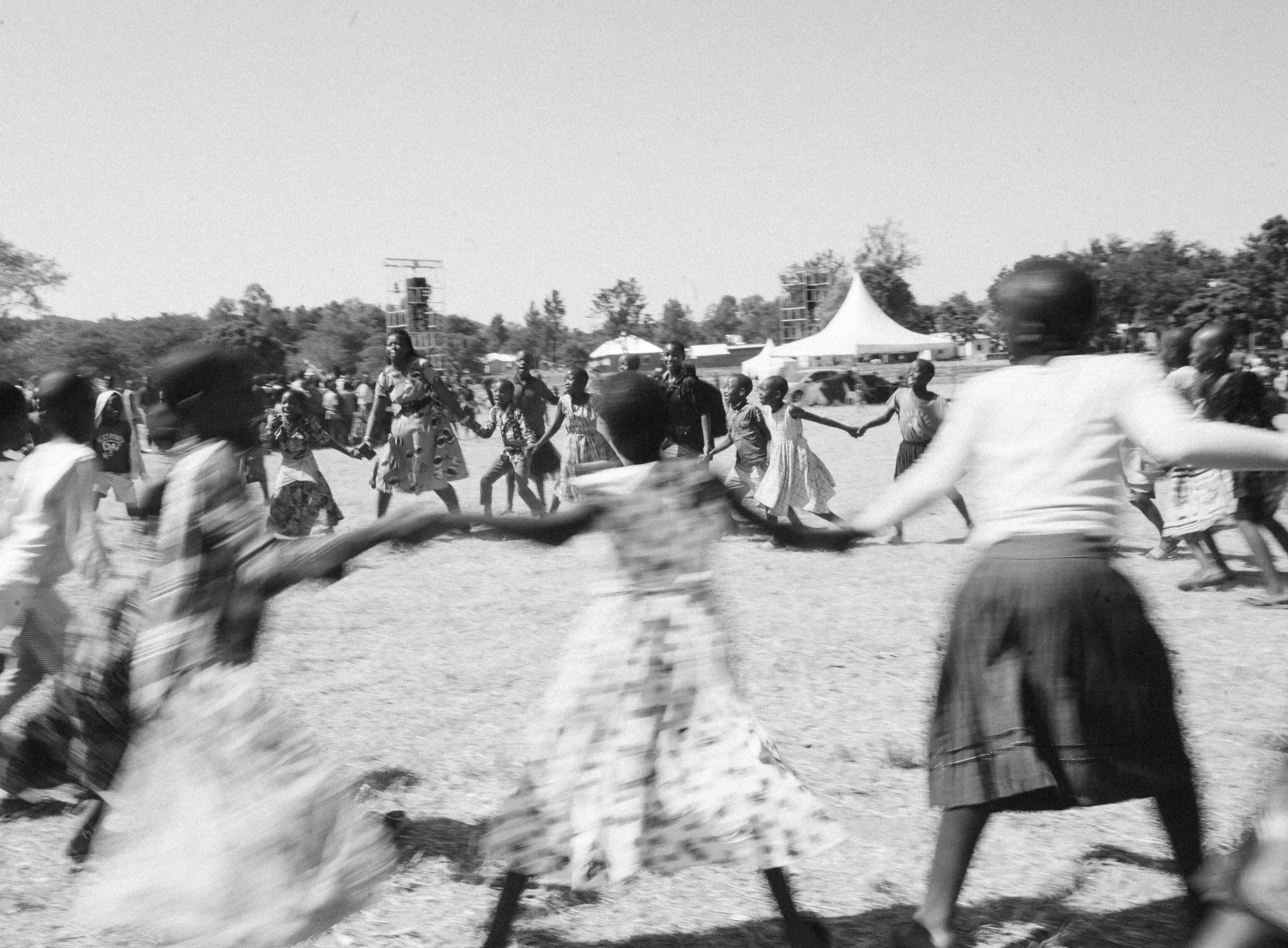
There is a specific kind of afternoon that no longer exists for most African children. The sun at a particular angle. A compound, a street, a stretch of open ground. No equipment beyond what the immediate environment provides: a bottle cap, a stone, a piece of chalk dragged across concrete, sometimes nothing at all except bodies and agreed-upon rules. And then a group of children, organized by nothing more formal than proximity and the shared understanding that this is how the hours between school and dinner get spent.
Nobody called it play. Nobody needed to. It simply was what children did, the way breathing is what people do, instinctively, without instruction, because the alternative is to stop functioning.
That afternoon is disappearing. Not all at once, and not everywhere at the same time, but consistently, across the continent, in the cities and increasingly in the towns, the conditions that made it possible are eroding. The compound gave way to the apartment. The street became too dangerous for unsupervised movement. The hours filled with structured activity, with screens, with the managed, monitored version of childhood that modernity tends to produce. And with those hours went something that we have not yet fully reckoned with, not just a set of games, but a particular way of becoming a person.

Before the games, there is play itself. And play, it turns out, is not a luxury. It is not downtime. It is not the thing children do when the important things are finished.
Developmental psychologist Brian Sutton-Smith spent decades studying what play does to the human mind and what its absence produces. His conclusion was stark:
"The opposite of play, is not work. It is depression."
Research psychologist Peter Gray, who has spent nearly fifty years interviewing thousands of people about their childhoods, puts it plainly: in the absence of free social play, children fail to acquire the social and emotional skills essential for healthy psychological development.
The evidence is consistent across disciplines. Children who are deprived of unstructured, self-directed play show measurable deficits in emotional regulation, problem-solving, and the capacity for empathy. They are more prone to anxiety, more rigid in their thinking, less able to tolerate ambiguity. Studies examining play deprivation across populations consistently find the same things: reduced ability to sustain cooperative relationships, a weakened capacity for communal harmony, and a tendency toward fixed, defensive ways of relating to the world. Play-deprived children, the research suggests, grow into adults who struggle to belong to social groups, because belonging is a skill, and like all skills, it has to be practiced.
This is what play is for. Not amusement, though it is that too. Not the burning of excess energy, though it does that as well. Play is how children learn to be among people. It is how they practice the social contract before it counts. It is, in the most direct sense, the rehearsal for community life.
Now consider what African traditional play was, and what it knew about this, long before the research caught up.
The games had names. Ten-Ten. Suwe. Boju Boju. Tinko Tinko. Police and Thief. Ayo. Each one arrived not from a box or a screen but from another child, who learned it from an older child, who learned it from someone else entirely, the whole chain running back further than anyone could trace.
Ten-Ten, the clapping and leg coordination game played in pairs, looks simple from the outside. Two people, synchronized movement, escalating difficulty. What it actually demanded was sustained attention to another person's rhythm, the patience to fail and try again, the willingness to coordinate your body to someone else's. You could not play Ten-Ten alone. The game did not exist without someone across from you. At its core, it was a lesson in synchrony, in the particular pleasure of moving in time with another human being.
Suwe required you to navigate shared territory according to agreed-upon rules. The chalked grid on the ground belonged to everyone, and your movement through it had to respect the boundaries that everyone had accepted. Ayo, the two-player seed-sowing game, is perhaps the most ancient. It runs across the entire continent under different names, Bao in Kenya, Omweso in Uganda, Isigoro in Rwanda, Nsolo in Zambia, because the same instinct that produced it appears to have existed everywhere on the continent simultaneously. It is strategy in its purest communal form: not the abstract strategy of a puzzle, but the relational strategy of sitting opposite someone you know, reading their thinking through their hands, learning them by playing them. Ampe in Ghana required you to read the moment of another person's jump. Police and Thief turned the whole compound into a negotiation about power, justice, and the social cost of being caught. Diketo in southern Africa demanded timing and coordination between the body's different impulses. Kgati, the rope-skipping game played across South Africa, was performance and rhythm, the kind of competence that only develops in front of people who are paying attention.
None of these games arrived with instructions. They were transmitted physically, through watching and joining and failing and trying again. The rules existed in bodies before they existed in language. And running through all of them was the same underlying architecture: you needed other people to play, the game rewarded those who could read and respond to other people well, and the entire experience built exactly the capacities that the research on play deprivation now identifies as essential to healthy human development. Not by accident. By design. African communities had understood for centuries what developmental psychology is only now articulating in papers.
The generation that grew up playing these games is, right now, between their thirties and fifties. Old enough to have children of their own. Old enough to remember the games, at least partially. Young enough to have already made the full transition to a different relationship with technology and leisure.
And here is the gap that no one is talking about clearly: remembering a game and being able to teach it are not the same thing. The rules of Ten-Ten live in muscle memory, not in language. The logic of Ayo requires someone to sit across from you and play with you. Boju Boju needs a physical space large enough to hide in, and the confidence that it is safe for a child to run around in it unsupervised, a confidence that is increasingly rare in urban environments where play has been moved indoors and onto screens.
The transmission is breaking not because the games were bad or irrelevant, but because the conditions for passing them on have changed in ways that nobody planned and nobody reversed. The compound gave way to the apartment. The street became a place adults were anxious about. The afternoon hours that once belonged entirely to children are now scheduled, monitored, and optimised. Nobody made a decision to stop teaching these games. The opportunity to teach them simply kept not arriving, and children, unlike seeds, do not wait.
There is a generation of African children growing up with play that does not belong to them. This is not an argument against technology. Screens are not the enemy, and condemning them is a distraction from the real question. The real question is: what stories are being learned?
The cities in the games most African children play today are not Lagos or Nairobi or Accra. The conflicts they navigate digitally are not shaped by the social textures of the communities they live in. The characters whose decisions they make, whose triumphs they experience, were designed by people who were not thinking about them when they built those worlds. This is fine as a supplement. It becomes a problem when it is the only language of play a child learns.
Traditional African games were not simply entertainment. They were socialization. Ayo taught strategy within a relationship. Police and Thief taught children to think about power and justice through their bodies, through the experience of running, being caught, having to negotiate. Nyama Nyama Nyama, the Kenyan game in which a leader calls out animals and players respond based on whether the meat is eaten in their culture, taught communal decision-making and quick cultural literacy. These games were teaching you how to be among your specific people, in your specific place, navigating the values and social logics that your community actually operated by.
A child who learns these things only from a game built in California or Tokyo is not learning them wrong. But they are learning them from a story that was not built for them, in a world that does not look like theirs, carrying values that may not map onto what their community will need from them. And the research is clear about what happens when children are not given the chance to practice, through play, the specific social and emotional skills their environment requires: they struggle to belong. They struggle to cooperate. They grow into adults who find communal life harder than it needs to be.

None of this is a rejection of modernity. Modernity is not the problem, and nostalgia is not the solution. The question is not whether African children should use screens or play video games. They will, and they should. The question is whether the intelligence embedded in traditional play has to disappear in the process.
Chess moved from a physical board to a digital one without losing its logic. The game is still chess. The strategy is identical. The fact that you can now play it on a phone against someone in another country did not erase what the game was. It simply changed the surface it runs on, and in doing so, ensured that the thinking it develops travels with the times.
Ayo could do the same. The rhythm and coordination of Ten-Ten could become a game mechanic. The social architecture of Police and Thief, the roles, the negotiation, the moral stakes, is not structurally far from what game designers spend years building from scratch. The raw material is there. The stories are there. The communities that created these games understood something profound about what human beings need from play, something that the most sophisticated modern research is only now confirming. What is missing is the decision to translate them, to take what these games understood and carry it forward into the forms this generation actually uses.
That translation will not happen by default. Nobody outside these cultures has the incentive to do it. The people who built the platforms and the devices and the game studios were thinking about their own cultural inheritance when they built their worlds, and they translated it faithfully. Their games teach their stories. Their play builds their children into participants in their world.
We have not done that for ours. And the longer we wait, the more of the original language we lose.
The games still exist, in pockets. Some schools are trying to revive them. Cultural organisations are documenting them before the knowledge disappears entirely. But documentation is not transmission. A child does not learn to play Ayo from an archive. They learn it from someone who sits across from them and plays.
What is at stake is not sentiment. It is not a wish that things were simpler or that modernity had not arrived. What is at stake is the specific kind of intelligence, social, emotional, communal, that these games were building, quietly, in compounds and schoolyards and on stretches of open ground across the continent. The capacity for communal harmony. The instinct for cooperation. The ability to read another person's rhythm and match it.
Play-deprived children, the research tells us, become adults who struggle to belong. African traditional play was, among other things, a lifelong inoculation against exactly that. It was teaching children to belong, not in theory, but in practice, in the body, in the afternoon, before it mattered.
The person who needs to begin that translation has to remember first. And remember clearly enough to know that what they are passing on is not a game. It is a way of being together that took centuries to build, and that we are, one unplayed afternoon at a time, quietly letting go.