Stay In This World
The stories, the culture, the conversations. Every week.
No spam. No third parties. Just Unruly.
From the streets and schoolyards to the television screens and gaming centres, the games we played tell a story about growing up in Nigeria.

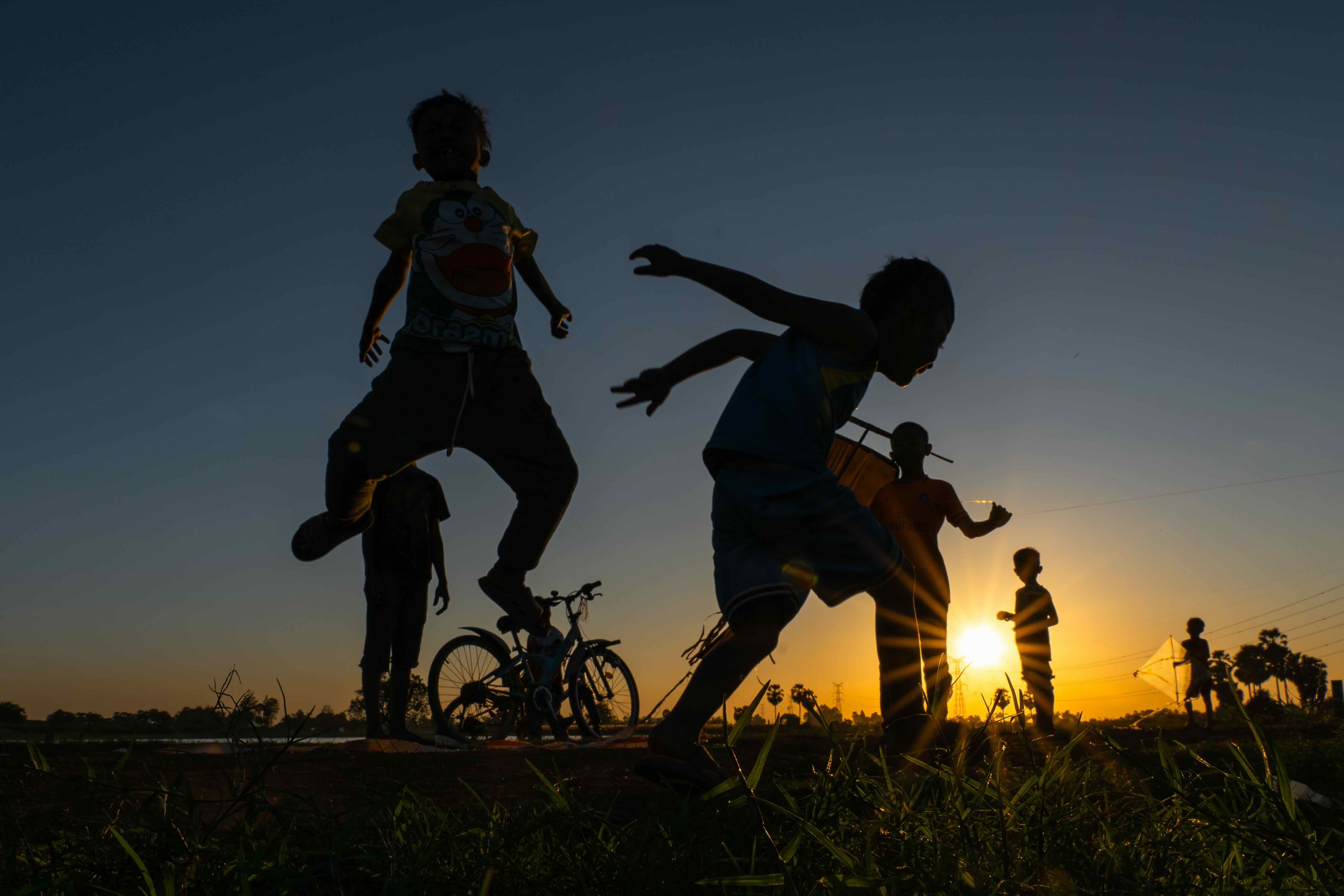
There was a time when entertaining yourself required very little. A few children, an open space, a piece of chalk, and enough time before someone’s mother called them inside could keep an entire afternoon occupied. Sometimes, even the chalk was unnecessary. All you needed was someone willing to play and a few others willing to follow.
A drawing on the ground could become an arena. An empty compound could become a football stadium. A game of hide-and-seek could turn familiar surroundings into a maze of hiding places, and a disagreement over whether somebody had been caught could become the most important argument of the afternoon.
These were ordinary experiences for many Nigerians who grew up in the late 1990s and early 2000s. They belonged to a childhood in which play was often something children organized for themselves, using whatever their immediate environment offered.
Suwe, ten-ten, boju-boju, skipping rope, police and thief, and the many variations of street football were more than ways to pass the time. They were part of the social fabric of growing up. Children learnt the rules, invented new ones, formed alliances, competed, quarreled, reconciled, and returned the following day to do it all over again.
But childhood does not remain the same forever. Neither do the things that occupy it.
As video game consoles became more familiar, gaming centres multiplied, and mobile technology made digital entertainment increasingly accessible, another kind of playground emerged. The experience of play began to stretch from the physical spaces children shared to virtual worlds they could enter through a screen.
Understanding this transition means looking beyond the games themselves. It means asking what they tell us about the places we grew up, the relationships we formed, and the changing experience of being a child in Nigeria.
For a child growing up in a neighborhood where other children were always within reach, the question was rarely whether there was something to do. The challenge was deciding what to play.
The games varied from place to place, and their names, rules, and popularity depended on the communities in which they were played. In Yoruba-speaking communities, suwe offered a test of balance, coordination, and precision. Players hopped through a grid drawn on the ground, often using a small stone as a marker, trying to complete the course without stepping on a line or losing their balance. Some versions included claiming squares or houses as players progressed. Research on traditional Yoruba children's games has examined how such activities encouraged physical mastery, environmental exploration, cognitive development, and social learning.
Ten-ten brought a different kind of coordination. Two players faced each other, clapping hands and moving their legs in rhythm. The challenge was to follow the pattern without making the wrong move. Skipping rope demanded timing and stamina, while hide-and-seek rewarded the child who understood the neighborhood well enough to find a hiding place nobody else would consider.
Then there were games that required little more than imagination. Police and thief gave children roles to inhabit and a story to perform. Street football needed a ball, or something that could serve as one, and a rough agreement about where the goalposts belonged. The rules could change depending on the available space, the number of players, or the child who owned the ball.
That last detail mattered. Whoever supplied the ball might have considerable influence over the game. A wall could become a boundary, slippers could become goalposts, and a patch of open ground could be transformed into a pitch.
Children did not always need adults to organize these experiences for them. They could create their own entertainment, negotiate the terms, and adapt when something went wrong.
The games also demanded something that is easy to overlook when remembering them as simple childhood pleasures: other people. You needed a partner for ten-ten, a group for hide-and-seek, and enough players to make football interesting. Even solitary moments of play often existed within a larger neighborhood of children who could join at any time.
Play was woven into the spaces where children encountered one another.
This was not a universal Nigerian experience. A child growing up in a densely populated Lagos neighborhood might have had a different relationship with outdoor space from one growing up in a smaller town or rural community. Gender expectations, family rules, disability, access to safe spaces, and economic circumstances also shaped which games children could play and with whom.
Still, these games offer a window into a familiar aspect of childhood for many Nigerians: the ability to turn the immediate environment into something entertaining. The playground did not always need to be built. Sometimes, children simply had to imagine it.
Ask someone to remember a childhood game and they may recall the activity itself. Ask them to describe what happened when somebody cheated, and the memory often becomes much more animated.
Who was out? Did the person actually step on the line? Was that hiding place allowed? Did the ball cross the boundary? Who was supposed to take the next turn?
These questions could provoke arguments of surprising intensity. Yet they reveal something about how children experienced games: the rules were not always fixed, and their interpretation depended on the people playing.
A child who disagreed with a decision had to make a case. Someone else had to defend the call. Sometimes the group reached an agreement; sometimes the game stopped until everyone was satisfied enough to continue. And sometimes the child who lost simply refused to accept defeat.
There was no guarantee that these negotiations were fair. Older children could dominate younger ones, stronger players could dictate the terms, and disagreements could become unpleasant. Childhood games were not perfect laboratories for cooperation. They reproduced some of the same conflicts and inequalities found elsewhere in life.
However, the most important thing was that they offered opportunities to navigate those conflicts.
Children learnt that rules mattered because everyone needed some understanding of what counted as winning or losing. They discovered that a game could collapse if nobody accepted its terms, and that changing a rule halfway through could create a fresh argument.
They also learnt how to adapt. When there were too few players, a game might be modified. When a ball was unavailable, another object might take its place. When a familiar space was occupied, children found somewhere else to play.
The games were therefore not only about physical activity. They were also about social negotiation and improvisation.
It is tempting to describe these experiences as evidence that an earlier generation was more resourceful or better socialized than children today. That would be too simple. Children still negotiate, collaborate, argue, and invent things in the present. Digital games can demand strategic thinking, coordination, patience, and cooperation, sometimes at remarkable levels of complexity.
The more interesting observation is that different kinds of play create different conditions for learning about other people.
And then those conditions began to change.
For some Nigerian children, the arrival of video games was not a sudden replacement of outdoor play. It was an addition to a growing collection of ways to spend time.
The history of gaming in Nigeria stretches further back than the PlayStation generation. Earlier consoles and arcade games had already introduced electronic entertainment to some households and public spaces. But access was uneven. Consoles, games, and the equipment required to use them could be expensive, meaning that a child did not necessarily need to own a console to become a gamer.
The neighbourhood gaming centre offered another possibility.
Sometimes it was a dedicated establishment. Sometimes it was a barbershop, a small business, or another space with a television and a console tucked into the corner. These places made gaming available to people who could not afford to own the equipment themselves.
Reporting on Nigeria's gaming culture has documented how some players first encountered PlayStation consoles in barbershops and other informal gaming spaces, paying small amounts for limited periods of play. GameDaily's account of Nigeria's gaming boom describes this hybrid model of gaming access, in which businesses and shared spaces helped introduce people to console gaming.
The experience was different from playing suwe in a compound. Instead of drawing a grid on the ground, you needed a television, a console, a game, and a controller. Instead of inventing the entire game yourself, you entered a world whose characters, objectives, and mechanics had been designed by somebody else.
Yet the social experience could be surprisingly familiar.
For many players, the attraction was not just the game on the screen. It was the person sitting beside them, the friend they wanted to defeat, the argument over a questionable goal, or the promise of a rematch. The controller became another object around which friendships and rivalries formed.
Football games, particularly the Pro Evolution Soccer series and its predecessors, became an important part of this experience for many Nigerian players. Winning Eleven, PES, and later FIFA offered opportunities to recreate football rivalries through virtual teams and tournaments. Players could debate formations, choose their favourite clubs, and spend hours trying to establish who was the better gamer.
A gaming centre could reproduce the competitive atmosphere of a street football match without requiring an open field. The contest had moved indoors, but the desire to win had not disappeared.
There was also a new economy around play. Time on a console could be purchased, meaning the length of a match or session was partly determined by how much money a player had. Access depended on where a gaming centre was located, what it charged, and if a child could persuade a parent to provide the money.
For some children, owning a console at home made gaming a regular feature of family life. For others, it remained an occasional treat or a shared experience outside the home.
This difference is important to note, because technological change rarely reaches everyone at the same time or in the same way. The childhood of a child with a PlayStation at home was not identical to that of someone who could only play during visits to a friend or at a gaming centre.
Still, the controller introduced a new kind of possibility. A child could enter a football stadium, race around a track, fight a fictional opponent, or explore an imaginary world without leaving the room, expanding their playground beyond their physical enviroment.
The next significant shift came as mobile phones and internet access became more widely available. Gaming no longer depended exclusively on access to a television and console. Increasingly capable phones offered another route into digital entertainment.
The change was not simply that children could now play indoors. Many had already done that. It was that the equipment required for play could become personal and portable.
Mobile games made it possible to play during a journey, between classes, while waiting for someone, or during a quiet afternoon at home. Games such as Candy Crush and Subway Surfers reached wide audiences, while online multiplayer titles later enabled players to compete or cooperate with people beyond their immediate surroundings.
Smartphones also changed the relationship between gaming and ownership. A child might not have a dedicated gaming console but could still access games on a shared or personal phone, depending on the household's resources and rules.
In this sense, digital technology could make certain forms of play more accessible even as other barriers remained. Data costs, device availability, electricity, internet quality, and parental restrictions continued to influence who could play and how often.
The social world of gaming changed alongside its accessibility. Children could still gather around a single screen, pass a phone between friends, or compete in the same room. They could also play with people in different neighbourhoods, cities, or countries.
The distance between players no longer had to be physical.
This development has consequences for how we understand childhood. In an outdoor game, the immediate environment often shaped the possibilities. Children needed a place to gather, and the people who happened to live nearby influenced who they played with.
Online games could create communities that extended beyond those geographical boundaries. Players could find teammates with shared interests, develop specialised skills, and become part of competitive communities that their immediate surroundings might not offer.
Research on children's digital technology use in Nigeria has explored both the opportunities and risks of growing up with connected devices. The Nigerian Communications Commission's study of young children and digital technology considers how children use digital tools for entertainment, communication, learning, and participation, alongside the risks that accompany online access.
Digital play, then, should not be understood simply as the disappearance of physical play. It has introduced new forms of participation, new relationships, and new possibilities for creativity and competition. But it has also changed the spaces in which these experiences take place.
It is easy to romanticise the past when remembering the games that occupied our childhood. Memory tends to preserve the exciting parts: the laughter, the rivalries, the afternoons that seemed to stretch endlessly, and the friendships that formed around a shared activity.
It can be less generous with the inconveniences. Not every neighbourhood had safe outdoor spaces. Not every child was welcome in every game. Some children had to work, complete household responsibilities, or remain indoors. Others had no nearby group of children with whom to play.
The past was not a universal playground. Nor has the present become a world without outdoor games. Children still play football in open spaces, jump rope, chase one another, invent games, and participate in traditions passed down by older siblings and relatives. Digital entertainment has become an important part of childhood for many, but it has not erased every older form of play.
Nevertheless, the conditions surrounding play can change.
Parents may worry about traffic, strangers, neighbourhood safety, or the availability of places where children can gather. Urban development can alter the spaces available for recreation. School schedules and household expectations can affect how much time children have. Digital entertainment offers an alternative that can be accessed without travelling to a field or assembling a group of neighbours.
These changes do not have a single cause, and they should not be attributed to technology alone.
What deserves attention is the relationship between play and the environment that supports it. If a child no longer has access to a safe place to play outside, a phone may offer entertainment, but the phone is not necessarily the reason the outdoor playground disappeared.
Likewise, if a child finds friendship and belonging through an online game, that relationship should not be dismissed simply because it exists through a screen.
The important question is what each environment allows children to experience, and what opportunities may be missing when one becomes less available.
A physical game can make a child attentive to the people and spaces immediately around them. A digital game can introduce them to new forms of storytelling, competition, problem-solving, and collaboration. Both can produce memorable experiences. Both can also be isolating or exclusionary, depending on how they are organised and experienced.
The challenge is not to choose one world and reject the other. It is to understand what makes play valuable and how children can continue to experience it in different forms.
For someone who grew up playing suwe or ten-ten, remembering these games may bring back more than the rules. It might recall the compound where the game took place, the friends who gathered after school, the person who always cheated, or the adult whose voice signalled that playtime was over.
For someone who grew up with a console or a smartphone, the equivalent memory might be a football tournament with friends, a game shared with a sibling, or the first time an online match connected them with people they had never met.
The objects differ. The environments differ. Even the meaning of a game can change from one generation to another.
But games offer a way to understand how children inhabit the worlds available to them. They reveal what resources they can access, how they spend time together, what they find exciting, and the kinds of communities they build.
This is why documenting childhood games matters. A list of names and instructions can preserve how a game was played, but the stories surrounding it can reveal how people lived. They help us understand the relationship between a game and its environment: the street that made it possible, the neighbours who participated, the objects that became equipment, and the friendships that outlasted the activity itself.
For those who experienced these games, remembering is an opportunity to revisit a part of their lives. For those who did not, the stories provide a glimpse into a childhood that might otherwise feel distant.
Neither generation needs to believe that its childhood was the better one.
The more useful task is to recognise that childhood is shaped by the world adults and children build around it. The spaces we provide, the technology we make available, the time we protect, and the communities we sustain all influence how children play.
Perhaps the most important question is not which games made our childhood, but what made those games possible in the first place. And as the world continues to change, what will make the games of today's children possible tomorrow?