Stay In This World
The stories, the culture, the conversations. Every week.
No spam. No third parties. Just Unruly.
The body was always a document. This is the story of what was written on it.
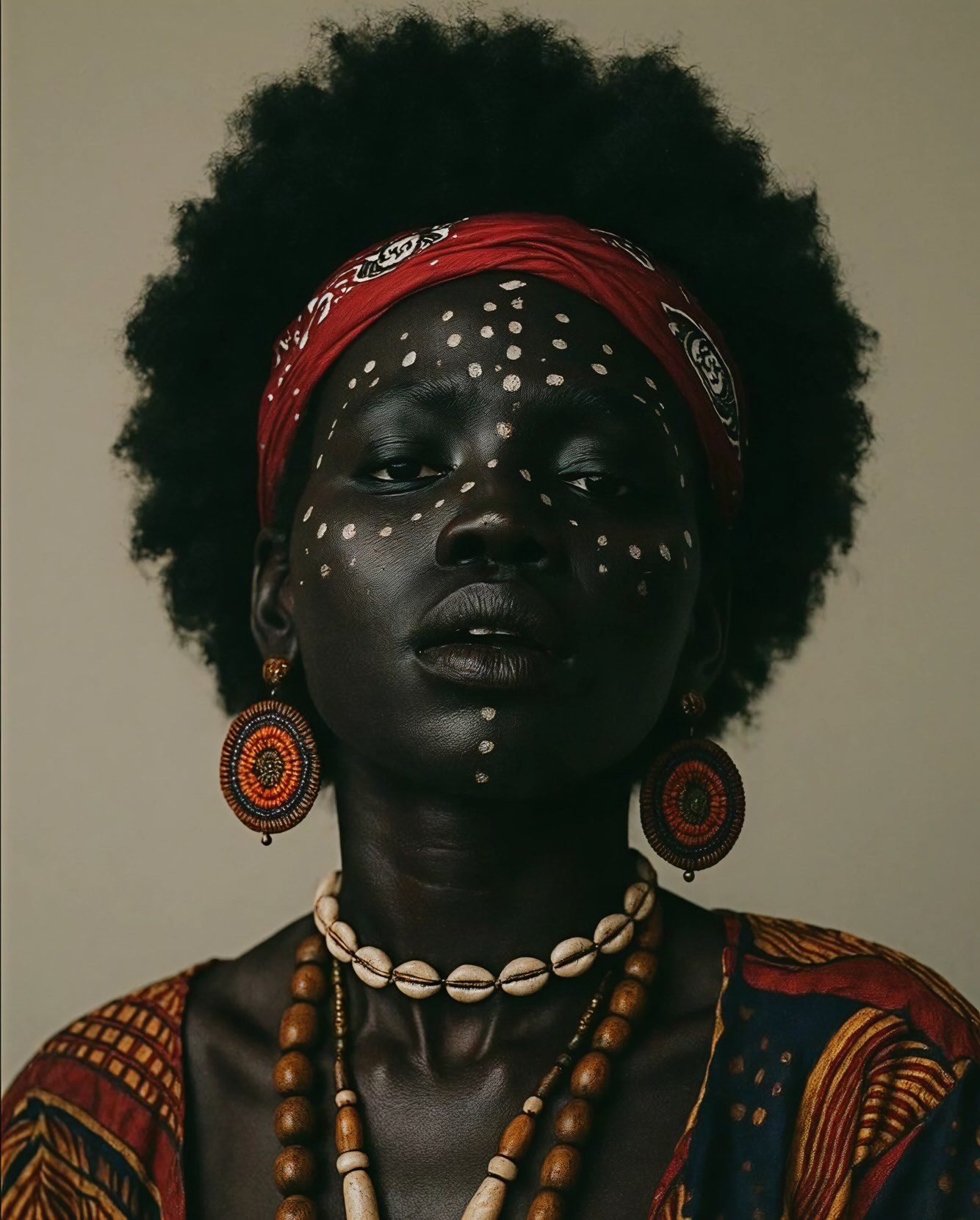
Before passports. Before borders drawn by men who had never walked the land they were dividing. Before the bureaucratic systems that now tell us who we are and where we belong, African people had already solved the problem of identity. They solved it in the most direct way possible: they wrote it on the body.
The skin was not a canvas in the decorative sense. It was a document. A record of lineage, community, spiritual affiliation, and life stage that traveled with its owner everywhere they went. You could not lose it, forge it, or have it taken from you at a checkpoint. It was, quite literally, you.
What the global beauty industry now sells as body art, tribal aesthetics, henna tattoos, and bohemian adornment is, in large part, the surface of something that was never decorative to begin with. Stripped of context, aestheticised, made available for purchase at festival stalls and nail bars from London to Los Angeles, these marks have traveled further than their makers ever imagined. The question worth asking is whether the meaning traveled with them.
Across the continent, the traditions of body marking developed differently, shaped by climate, cosmology, and the specific values each community chose to make visible. But the underlying logic was consistent: the body was the most permanent and personal record available, and what was placed on it carried weight.
Among the Yoruba of southwest Nigeria, facial markings known as Ila encoded a person's identity with extraordinary specificity. A single set of marks could tell you a person's hometown, family lineage, and clan. During the era of the transatlantic slave trade, these marks became something else entirely: a way for enslaved people to find each other across the horror of displacement, to recognize a face from home in a foreign land and know, without speaking, where that person came from. The marks that began as citizenship became, under those conditions, a form of resistance. A quiet insistence on remaining legible to one's own people even when everything else had been stripped away.
The Igbo tradition of Uli body painting operated differently but carried equal intentionality. Applied by women using juice from the uli plant, these flowing geometric designs were not permanent: they were renewed, reapplied, alive. They marked ceremony, transition, and status. They decorated the living body for significant moments, and the same visual language that ran across skin also ran across walls, pottery, and cloth. The body was not separate from the visual culture. It was continuous with it.
Further north, among the Nuba peoples of Sudan's Kordofan region, scarification tracked a woman's life with unusual intimacy. The first marks came at puberty. A second set arrived with the first menstrual period. A final, extensive phase of scarring followed the weaning of a first child. The body became a timeline, an autobiography written in raised skin, recording the passages that defined a woman's life in her community. These were not marks given in a single sitting but a decades-long conversation between a woman and the culture she belonged to.
In North Africa, Berber women wore permanent tattoos of geometric shapes, dots, and lines on the forehead, chin, and cheeks. Each design carried specific meaning: protection against harm, invitations to good fortune, markers of beauty and tribal belonging. Henna, which has been used across North Africa, West Africa, and the Horn of the continent for over five thousand years, moved between permanence and impermanence with a fluidity that Western beauty culture is only beginning to understand. Ancient Egyptians used it in burial preparation, believing it retained a person's spirituality. Along the trade routes, it traveled with merchants and pilgrims, adapting to the ceremonies of each culture it entered while retaining its essential meaning: this moment matters, and the body will mark it.
The decline of these traditions is not a single story. It happened differently in different places, through different pressures. But the broad shape is familiar.
Colonial administrations and Christian missionary activity treated body marking as evidence of savagery, something to be eradicated as part of the civilising project. The same marks that encoded centuries of cultural intelligence were reframed as primitive, as shameful, as obstacles to modernity. Communities that had maintained these practices for generations were pressured, sometimes violently, to abandon them. Schools refused children who bore marks. Churches condemned the practice. The law, in some places, followed.
At the same time, it is necessary to be honest about something that a purely nostalgic reading of this history tends to obscure: some of these practices caused real harm. Scarification performed on infants and young children, on bodies too young to consent, carried pain without choice. The specific tradition of marking women at prescribed life stages, however meaningful within its own logic, was not always entered freely. The decline of these practices in their most coercive forms is not a loss. It is, in part, a correction.
What was lost was not the harm. What was lost was the meaning: the understanding that the body could be a record, that adornment could be a language, that the marks we choose to carry say something true about who we are and where we come from.
What is happening now, across the continent and in the diaspora, is something more precise than revival. It is a reclamation: a deliberate choice to recover the meaning while leaving behind the methods that caused harm.
Contemporary African tattoo artists are drawing consciously from scarification patterns and geometric traditions, translating the visual language of Ila, Uli, and Berber tattooing into permanent ink applied by choice, in adulthood, to a body that has consented. The mark still means something. The lineage is still being honored. But the context has shifted from obligation to expression, from imposition to claim.
Henna is experiencing a similar moment. Across Nigeria, Sudan, Morocco, and their diasporas, younger generations are returning to henna not as a relic but as a living practice, bringing contemporary aesthetics into conversation with traditional patterns. The geometric designs of North Africa, the flowing forms of West African application, the bridal traditions that marked transitions across dozens of cultures: these are being practiced, photographed, and shared by people who understand both what they are doing and why it matters that they are the ones doing it.
This distinction is not incidental. It is the whole point. When an African woman applies henna patterned after a Berber tradition she has researched and chosen, she is doing something categorically different from when the same pattern appears on a festival wristband sold by a brand with no knowledge of its origin. The mark is the same. The meaning is entirely different.
The global beauty industry's relationship with African adornment traditions follows a pattern that will be familiar to anyone paying attention. The aesthetic arrives first, traveling through fashion editorials, festival culture, and social media. The context arrives later, if at all, usually in the form of a controversy about appropriation that briefly interrupts the commerce before things return to normal.
What gets lost in that cycle is not just attribution. It is the understanding that these marks were never decorative. They were epistemic. They were a way of knowing and being known. When Yoruba facial markings are reproduced as face paint at a music festival, what disappears is the centuries of meaning behind the specific pattern, the fact that those particular lines once told a person's community exactly who they were and where they came from. The pattern travels. The knowledge does not.
This matters because knowledge, once separated from its source, does not automatically return. The communities that developed these traditions are the only ones with the standing to determine how they evolve, what they mean in contemporary contexts, and which elements are available to share and which are not. That is not protectionism. It is the basic logic of cultural authorship.
The most interesting thing about the current moment is that it is not primarily about loss. It is about choice. A generation of African people is deciding, consciously and on their own terms, what they want to carry forward from traditions that were disrupted but not destroyed.
The scarification practices that caused harm to women and children are not being revived, and they should not be. But the visual languages those practices encoded, the geometric intelligence of Berber tattooing, the flowing forms of Uli, the lineage-marking logic of Ila, are being translated into forms that belong to this moment. Permanent ink applied by choice. Henna renewed by hand at celebrations that still mark what they always marked: transition, belonging, the desire to make a significant moment visible on the body.
The skin is still a document. What has changed is who holds the pen.
African adornment was never about aesthetics alone. It was about saying: I am from somewhere. I belong to someone. I have passed through something. These marks prove it.
That instinct did not disappear with colonialism. It went underground, adapted, and is now returning in the hands of people who understand what they are reclaiming and why it matters that the reclamation is theirs.