Stay In This World
The stories, the culture, the conversations. Every week.
No spam. No third parties. Just Unruly.
In Brazzaville, elegance is not a luxury. It is a philosophy, a resistance, and a way of insisting on your own dignity.
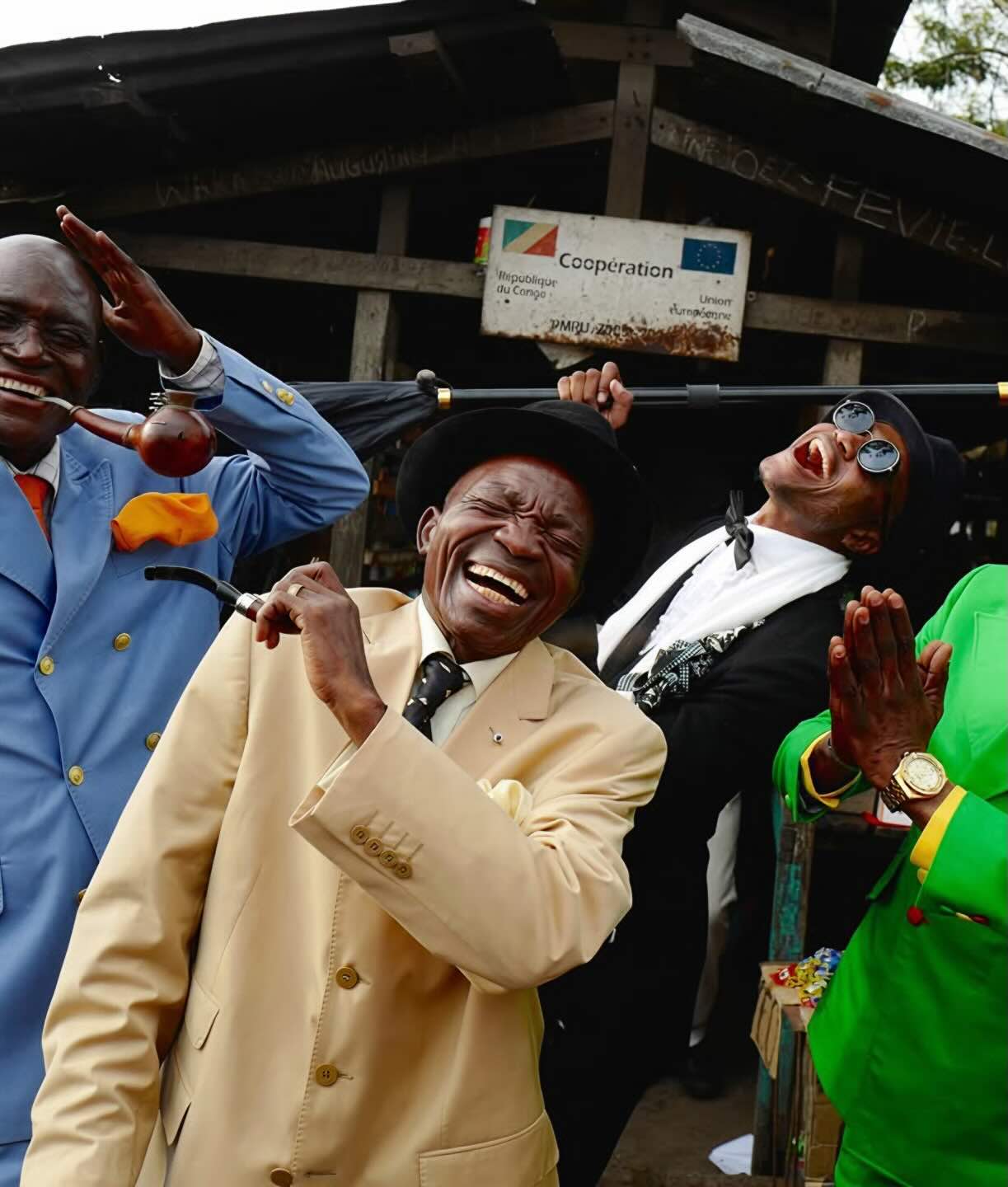
On a weekday morning in Bacongo, one of Brazzaville's most densely populated neighbourhoods, a man drives a taxi through streets that carry the weight of a country still finding its footing. He finishes his shift, goes home, and opens his wardrobe. What comes next is not a change of clothes. It is a full on transformation.
He selects his suit with the precision of a surgeon. The colours cannot number more than three. The cut must be exact. The shoes must be polished to a specific standard. He arranges his pocket square, takes up his cane, and steps back into the same streets he left an hour ago, now turned runway. The neighbours gather. People stop. Some applaud. He walks as though the city was built for precisely this moment.
He is a sapeur, a member of SAPE: the Société des Ambianceurs et des Personnes Élégantes, or the Society of Ambiance-Creators and Elegant People. And what he is doing is not performance for its own sake. It is something considerably older and considerably more deliberate than that.
The roots of SAPE reach back to the colonial period, to the particular and painful intimacy of the servant and the master. Congolese men working in the households of French aristocrats in Paris observed how their employers dressed. They absorbed the grammar of European elegance, and began to apply it themselves. When they returned to Brazzaville, they brought the clothes with them, and something more important than the clothes: the understanding that dress carried power.
In 1922, a man named Grenard André Matsoua returned from Paris dressed in the codes of French elegance, and this moment is widely regarded as the movement's first statement. What followed was not imitation. It was appropriation in the fullest sense: taking something that had been used to establish hierarchy and turning it into a tool of dignity. By dressing like their colonial masters, the sapeurs were not paying them tribute. They were refusing to accept the position those masters had assigned them.
The movement formalised steadily. In 1978, Christian Loubaki opened La Saperie, the first dedicated boutique in Bacongo, and the community began to develop its own strict internal codes. SAPE was no longer simply a way of dressing. It had become an ideology.
What distinguishes the sapeurs from other subcultures built around fashion is the weight of the rules and the seriousness with which they are observed. A sapeur should never wear more than three colours at once. The suit must fit perfectly, never too large. It should not be worn on consecutive days. Accessories, an umbrella, a pipe, a fedora, a cane, are not optional flourishes but essential components of the complete statement.
But the clothes alone are not enough. The SAPE has always insisted that what cannot be purchased is as important as what can. Gestures, posture, gait, the specific way a man carries himself down a street, these are trained and refined over years. Baudouin Mouanda, the Congolese photographer whose 2008 series Sapologie brought the movement to international attention, described the sapeurs' relationship to their streets as one of theatre and genuine conviction simultaneously. "The Westerners made the dress," he said, "but how it is worn was invented in Brazzaville."
A popular saying within the community instructs that a sapeur should dress like a garden: bright, like a flower, eye-catching above all else. The goal is not to blend into the city but to interrupt it, to turn the ordinary street into a space where beauty insists on existing. One of the SAPE's founding commandments reads: "To dress oneself here on earth as it is in heaven." That instruction is not metaphorical. It is a statement of intent about what everyday life ought to look like.
Almost half of Congo's population lives at or below the national poverty line. The average annual income sits around three thousand dollars. The sapeurs are not wealthy men. Most have working-class occupations: taxi drivers, tailors, cobblers, gardeners, shopkeepers, electricians. They spend carefully, save deliberately, and sometimes buy second-hand. The suit that reads as extravagance from the outside is often the product of months of accumulated discipline.
This is precisely what makes the movement's philosophy coherent rather than contradictory. The sapeurs are not pretending to be rich. They are refusing to be defined by the economic conditions that surround them. The elegance is not a display of social status. It is a declaration that social status does not have the final word on how a man presents himself to the world.
One sapeur interviewed about the practice put it simply: the man who wears the suit is not hiding from his life. He is refusing to let his life be the only thing that defines him. The two hours of each day when the taxi driver becomes a dandy are not an escape. They are, in his view, an expression of what he actually is.
Mouanda was born in Brazzaville in 1981 and became interested in photography at thirteen, eventually earning the nickname "Photouin" while chronicling his city for local newspapers. His work covers the full range of Congolese life: the aftermath of civil wars, the effects of climate change, the realities of poverty. But it was his series Sapologie, shot in 2008 in the Bacongo neighbourhood, that carried his name beyond the continent.
The series was first exhibited at the Musée Dapper in Paris and went on to travel widely, earning Mouanda the Young Talent Award at the Encounters of African Photography in Bamako in 2009. What he captured in those images was not simply men in striking clothes. He captured the specific quality of pride that the SAPE produces in its members, the way a man stands differently when he is fully dressed, the way the street changes around him. He photographed the sapeurs where they lived, not in studios or in foreign contexts, insisting that the contrast between their surroundings and their clothing was not something to be erased or softened. It was the point.
That contrast is what the movement itself has always been built on. The beauty of the suit is inseparable from the difficulty of the life around it. The one does not cancel the other. They exist in deliberate and productive tension.
For most of its history, SAPE was exclusively a male space. The codes, the competitions, the communal rituals of dressing and promenading, these were transmitted through the male line and governed by a masculine understanding of what elegance required. In recent years, that has begun to shift.
Women have joined the movement in growing numbers, adopting the same codes of dress: suits, pipes, fedoras, canes, pocket squares. One of the first female sapeurs, Messanie Grace, helped establish that the philosophy was never really about gender. It was about the claim to dignity, and that claim belongs to anyone willing to make it. The women who have entered the SAPE dress like men in the sense that they follow the same rules. But they are doing something distinctly their own: taking a space that was built around one kind of resistance and expanding its terms.
The movement is spreading beyond Brazzaville and Kinshasa, finding adherents across central Africa and among Congolese diaspora communities in Europe. British designer Paul Smith has cited the sapeurs as an influence. A 2014 Guinness advertisement brought them to a global audience. None of this has changed the essential nature of what happens in Bacongo on a Sunday afternoon, when a man in a three-piece suit walks the length of a dusty street and the neighbourhood gathers to watch.
The suit is still the statement. The street is still the stage. And the argument being made, that beauty is a right and not a privilege, that elegance can coexist with hardship without diminishing either, is still the same argument it has always been.