Stay In This World
The stories, the culture, the conversations. Every week.
No spam. No third parties. Just Unruly.
The Ga tradition of fantasy coffins and the philosophy of identity they carry.
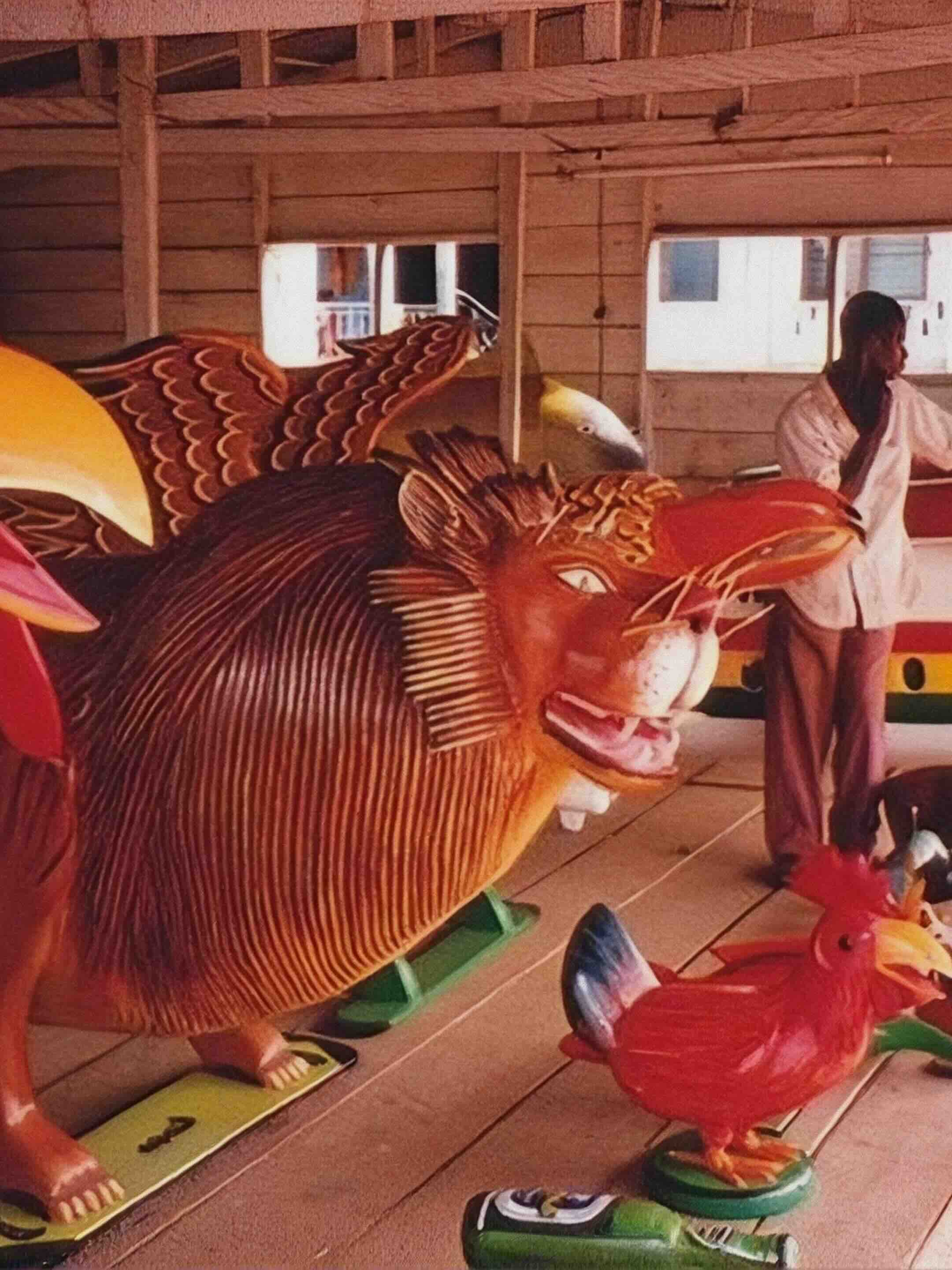
Somewhere in the coastal town of Teshie, on the outskirts of Accra, a carpenter is building someone's last possession. It might take the shape of a fish, painted silver and scaled with careful detail. It might be a mobile phone, a cocoa pod, a Mercedes-Benz, a hen surrounded by her chicks. Whatever form it takes, it will be large enough to hold a body. It will be lowered into the ground. And it will be the most honest portrait anyone has ever made of the person inside it.
The Ga people of Ghana's Greater Accra coast call these coffins abebuu adekai. The phrase translates, roughly, as receptacles of proverbs, or proverb boxes. The name is precise. A proverb, in Ga culture as in most West African traditions, is not a decoration of language. It is a compressed truth, something that carries more meaning than its surface suggests. The coffin does the same work. Its shape is not chosen for spectacle. It is chosen because it tells the truth about a life in a way a plain box never could.
To understand why the coffin looks the way it does, you have to understand what the Ga believe happens when someone dies.
For the Ga, death is not an ending. It is a passage into a different form of the same life. The ancestral realm, in Ga cosmology, is not a separate existence sealed off from the living world. It is a continuation of this one. The dead remain present, watchful, and influential. They protect the families they left behind. They can be pleased or displeased. They can intervene. And the way they are treated at the moment of departure directly shapes the relationship between the living and the dead for years afterward.
This is why a Ga funeral is not a quiet thing. A Ga funeral is typically held on a Saturday and can run through the night, with music, dancing, drumming, and crowds that fill entire streets. The bereaved wear black and red. There is food and drink and noise. From the outside, it can look like a celebration, and in a sense it is, because the point is not to mourn a loss but to ensure a proper arrival. The dead must be sent off in a way that reflects their dignity, their standing, and their identity. A poor sendoff is not a minor oversight. It is a spiritual failure with consequences that outlast the funeral itself. The coffin, in this context, is not furniture. It is the vehicle by which a person's identity travels into the next life. What it looks like matters, because what it looks like tells the ancestral world exactly who has arrived.
The tradition as it exists today traces back to a single accidental commission in the 1950s, in Teshie, a Ga settlement on the eastern edge of Accra whose carpenters had long built the fishing canoes that sustained the community.
Seth Kane Kwei was a young carpenter in Teshie when a Ga chief commissioned him to build a palanquin, the ceremonial chair used to carry chiefs through crowds during festivals, in the shape of a cocoa pod. The cocoa economy was at the center of Ghanaian life in the 1950s, and the shape was a statement of status and prosperity. Kane Kwei built it. But the chief died before the festival arrived, and the family, faced with the question of what to do with a large, beautifully carved cocoa pod that had been built for a man who would never sit in it, decided to bury him in it instead.
At the funeral, the coffin stopped people. The crowd saw something they had not seen before, not just a box, but a portrait. Within weeks, people in Teshie began approaching Kane Kwei with requests. A fisherman wanted to be buried in a fish. A farmer in an onion. A woman who had spent her life selling goods at market wanted something that reflected the years she had stood behind her stall.
Kane Kwei had not invented the philosophy behind the coffins. The Ga had always believed that the dead should arrive in the ancestral world with their identity intact. What he had done, almost without intending to, was give that belief a new and specific form. He had also, crucially, democratized it. Before his workshop, elaborate figurative objects at Ga funerals had been largely the preserve of chiefs and people of significant standing. After it, a fisherman could be buried with the same dignity as a chief, as long as the coffin told the truth about who he was.
His workshop in Teshie became the origin point of a lineage. Paa Joe, one of his apprentices, went on to become one of the most celebrated coffin makers of the following generation, whose work entered the permanent collections of museums including the British Museum. Eric Adjetey Anang, Kane Kwei's grandson, continues the craft today, working from the same Teshie tradition his grandfather established by accident in the decade after Ghanaian independence.
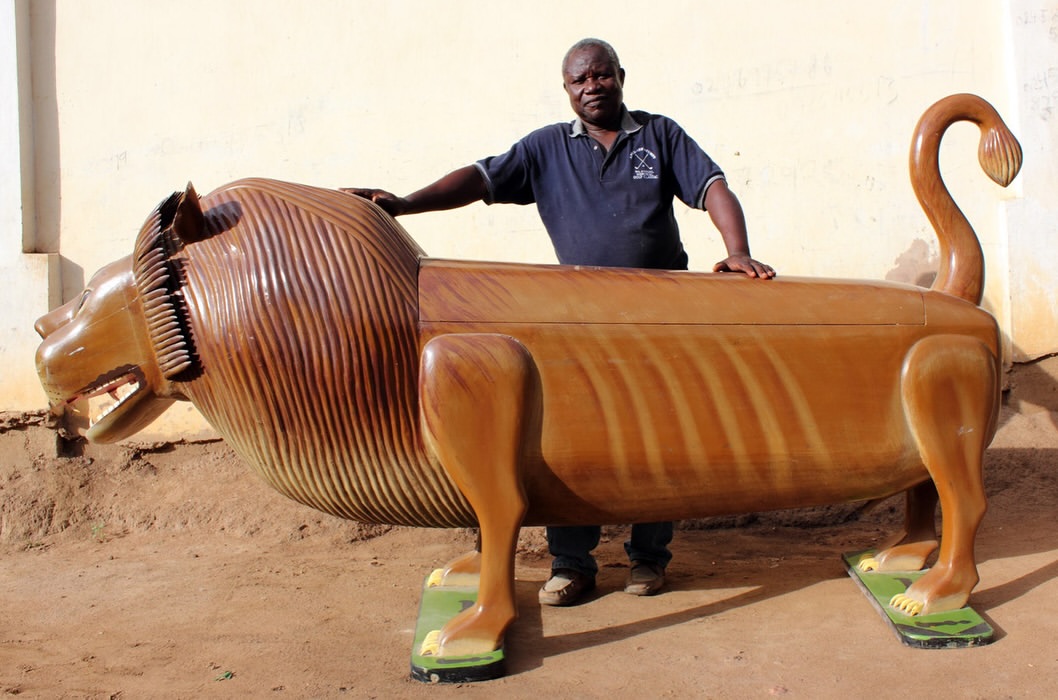
The range of shapes the coffins take is worth sitting with, because the variety is itself an argument. A fisherman buried in a giant fish. A cocoa farmer in a cocoa pod. A businessman in a Mercedes-Benz. A chief in a lion or an eagle. A photographer in a camera. A tailor in a sewing machine. There are coffins shaped like sneakers, mobile phones, Coca-Cola bottles, pineapples and so much more. The shapes have kept pace with Ghanaian life, so that as new professions, new technologies, and new markers of identity entered the culture, new coffin forms followed.
What the shapes share is a refusal of abstraction. Each one is specific to a person, chosen by the family in consultation with the coffin maker. Most often the choice reflects occupation: the fisherman buried in a fish, the cocoa farmer in a cocoa pod, the tailor in a sewing machine. Sometimes it reflects aspiration, the airplane for someone who dreamed of flying but never did, the luxury car for someone who reached for a life of prosperity. Either way, the coffin is a portrait. Not a generic farewell, but a specific account of a specific life.
This specificity is the point. Most funerary traditions across the world move in the opposite direction, toward the universal. White cloth. Plain wood. A marker with a name and two dates. The visual language of death in most cultures is designed to make loss legible across distances, to reduce a person to the information that a stranger can absorb. The abebuu adekai does the opposite. It insists on particularity. It says that the distance between one person and another is not something to be smoothed over at the moment of departure, but honored.
The coffins are also functional. They are not ceremonial objects that accompany the body. They are the coffin. They go into the ground. The painted fish, the carved Mercedes, the wooden camera, all of it returns to the earth with the person inside. There is something in that which resists the art world's appetite for these objects, which have been exhibited in galleries and museums across Europe and North America. The original context is not display. It is burial. The coffin was always meant to disappear.
The abebuu adekai has attracted significant international attention since the 1980s, when Paa Joe's work appeared at the Magiciens de la Terre exhibition in Paris in 1989, one of the first major Western exhibitions to present African contemporary art alongside Western work on equal terms. Since then, fantasy coffins have entered museum collections, been written about in design publications, and become one of the most recognizable images associated with Ghanaian culture in the global imagination.
That visibility has produced its own complications. The coffins that appear in galleries are typically made for exhibition rather than burial, commissions that ask the artisan to produce something for display rather than for the ground. The market for collectible fantasy coffins is real, and it exists almost entirely outside Ghana. There is a version of this story where a sacred funerary tradition becomes an export product, appreciated for its visual boldness without the belief system that gave it meaning. That tension has not been fully resolved.
But inside Teshie, and across Ga communities in Greater Accra, the practice continues on its own terms. Families still commission coffins from workshops that carry the lineage Kane Kwei established. The consultation still happens, the family describing the person, the coffin maker translating that description into form. The coffin is still revealed at the funeral, often the first time the crowd sees it, still a surprise, still a portrait.
What the abebuu adekai has always understood, and what makes it worth the attention it receives, is something quietly radical about how identity works. Most cultures treat death as the event that finally separates a person from their particularity, the moment when they become universal, a soul, a memory, a name on a stone. The Ga tradition pushes back against that. It says that who you were in life is who you are in death, that the fisherman goes to the ancestral world as a fisherman, that the photographer arrives as a photographer, that the life you lived is the only credential you need and the coffin should say so clearly.
It is a philosophy that insists on the dignity of ordinary lives. Not the lives of chiefs and generals and people whose names get written into history, but the lives of people who sold things in markets and caught fish before dawn and raised chickens and drove taxis and sewed clothes for their neighbors. The abebuu adekai says those lives are worth a portrait. That the truth of them deserves to travel.