Stay In This World
The stories, the culture, the conversations. Every week.
No spam. No third parties. Just Unruly.
Tolu Coker showed to the King. Bubu Ogisi is LVMH's only Black finalist. But who's building the infrastructure that makes success sustainable?
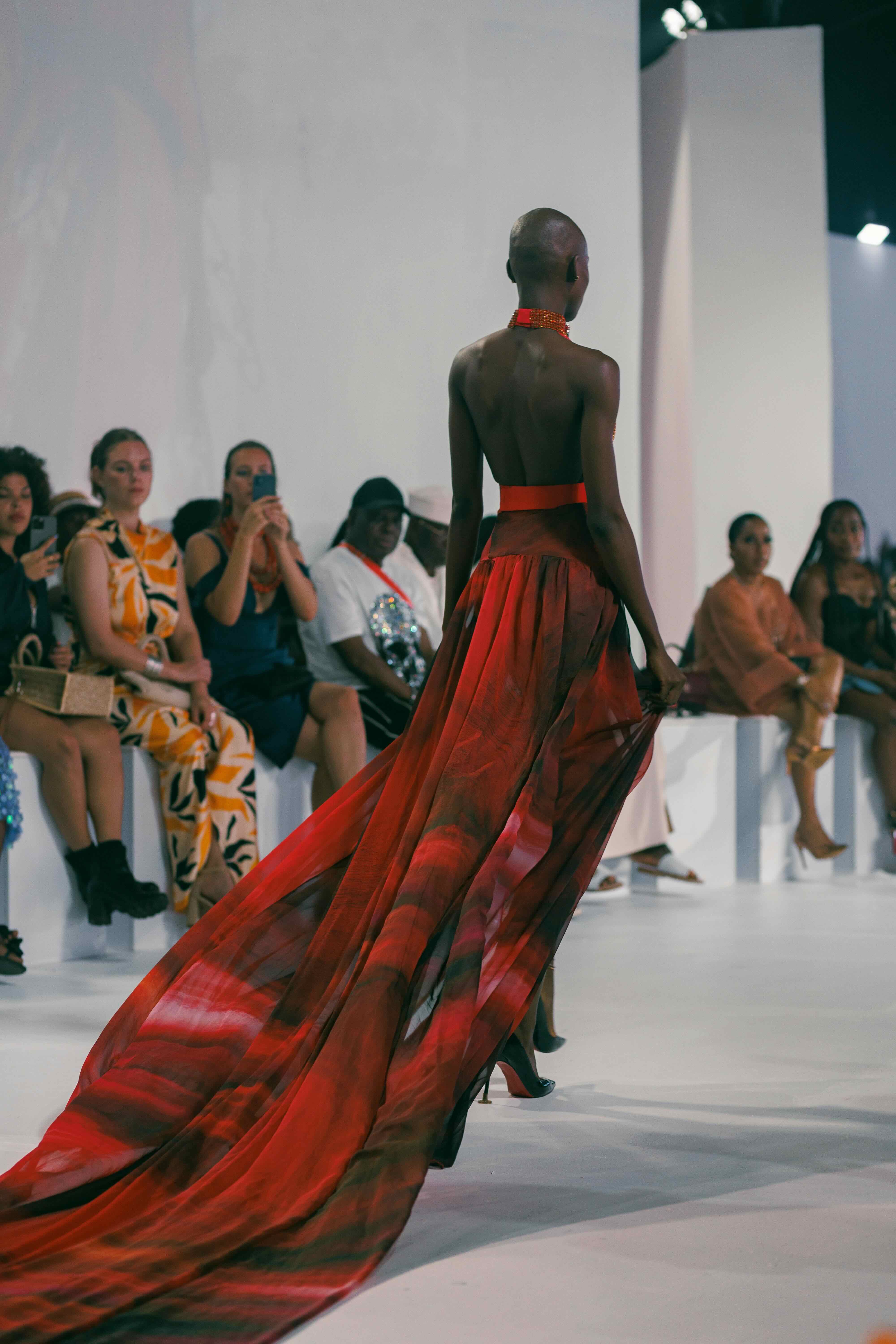
The King of England sat front row at Tolu Coker's AW26 show during London Fashion Week. Models walked in structured silhouettes that referenced both British tailoring and Nigerian textiles, the kind of fusion that fashion magazines love to call "groundbreaking" without interrogating what ground is actually being broken or for whom.
Coker titled the collection "Survivor's Remorse." In her own words:
"This show is my ode to Britain and London in truth. To social mobility and the council estate spaces that incubated me through adolescence, joy, grief, guilt, and finding my way back home. To the cage we played in, laughed in, learned in. It's a love letter to our inner children and to those we have loved and lost. Proof that grief and joy can exist in the same breath, and that community is qualitative wealth money cannot buy."
This wasn't about the fashion industry. It was about class mobility in Britain—the specific weight of being the one who makes it out while others don't. The guilt that comes with elevation. The grief that coexists with gratitude. The King's presence wasn't lost on anyone: here was a girl from council estates showing her work to literal royalty, embodying the very social mobility her collection mourned and celebrated.
But Coker's personal story of survivor's remorse sits inside a larger pattern that's been building for years: Nigerian designers are everywhere on international runways right now. They're finalists for major prizes, hosting fashion shows across Europe, getting the kind of visibility that was unimaginable a decade ago. And yet, something about this moment feels incomplete. Visibility has arrived, but infrastructure lags behind. Individual designers are "making it," but the ecosystem that would sustain the next generation remains underfunded, underbuilt, fragile.
The question isn't whether Nigerian fashion has talent—that's been proven repeatedly. The question is what happens after you make it. Who profits? Who gets left behind? And what does success actually mean when it's measured in European stages rather than local sustainability?
Bubu Ogisi of IAMISIGO is a 2025 LVMH Prize semi-finalist. She's also the only Black designer in this year's cohort.
This isn't an anomaly—it's a pattern. Nigerian designers show up consistently in LVMH Prize shortlists, often as the sole African or one of very few Black designers among predominantly European finalists. Kenneth Ize was a finalist in 2019. Lagos Space Programme made the list in 2020. Thebe Magugu from South Africa won in 2019—the first and only African designer to ever win the prize since its inception in 2014.
Let that sit: in over a decade of LVMH Prize, one African winner. Meanwhile, Nigerian and broader African designers appear regularly in semi-finals and shortlists, visible enough to signal diversity, rarely validated enough to actually win.
The prize comes with €300,000 and a year of mentorship from LVMH executives—transformative resources for independent designers. But the structure itself reveals something about who gets to be a gatekeeper. LVMH, the French luxury conglomerate that owns Louis Vuitton, Dior, Fendi, and dozens of other brands, positions itself as the arbiter of global fashion talent. The prize isn't just recognition, it's validation from the institution that controls much of the industry's infrastructure, distribution, and capital.
When Bubu Ogisi stands as the only Black designer in the 2025 semi-finals, what does that communicate? That Black designers are rare? That talent is scarce? Or that the systems determining who gets recognized are still fundamentally European, still operating from aesthetic frameworks that see Nigerian design as interesting, exotic, worth a shortlist mention, but not quite ready to win?
IAMISIGO, Ogisi's brand, is built on exploring Black identity and queer liberation through fashion. The garments reference Nigerian textiles, African diasporic histories, the complexities of navigating multiple identities across geographies. It's conceptually rigorous and commercially viable, exactly the kind of work that should be winning these prizes. But year after year, the prize goes elsewhere, and the pattern holds: visibility without validation, presence without power.
Orange Culture showed at Berlin Fashion Week earlier in February. Founded by Adebayo Oke-Lawal, the brand has become a fixture on international runways—Berlin, Paris, New York. The garments challenge gender norms, blend traditional Nigerian textiles with contemporary silhouettes, and have been worn by everyone from Skepta to Jidenna.
Tokyo James, founded by Iniye Tokyo James, has shown at Paris Fashion Week multiple times. The brand's tailoring draws from both Savile Row precision and Nigerian craft traditions, creating something that fashion press loves to describe as "East meets West" even though that framing erases the specificity of what's actually happening: Nigerian design being forced to prove itself legible to European audiences before it's taken seriously.
These designers have visibility. They're on international stages, in fashion publications, worn by celebrities. But visibility and sustainability aren't the same thing. Showing at Berlin Fashion Week or Paris Fashion Week is expensive: production, travel, models, venue, PR. For independent designers without corporate backing, these shows are often loss leaders, investments in the hope that buyers will place orders, that press will translate to sales, that visibility will eventually mean viability.
The economics are brutal. Most independent fashion brands operate on thin margins. International shows offer exposure but rarely immediate profit. Designers need buyers—department stores, boutiques, online retailers—to actually purchase their collections. And buyers, especially European and American buyers, often prefer designers who've already been validated by the industry's gatekeepers. You show in Paris to get into Dover Street Market. You get shortlisted for LVMH to convince Net-a-Porter to stock your line. You build your business around proving yourself to institutions that were never designed with you in mind.
Here's what's less visible: while Nigerian designers dominate international runways, the infrastructure to support fashion as an industry in Nigeria remains underdeveloped.
Lagos Fashion Week exists and has grown in prominence, but it doesn't command the same industry attention or buyer presence as London, Paris, or New York. Local production facilities can't always compete with the scale and specialization available in Italy or France. Fabric sourcing, which should be an advantage given Nigeria's rich textile traditions, is complicated by inconsistent supply chains and import/export challenges. And perhaps most critically, the local market—Nigerian consumers with disposable income—is smaller and less stable than the international markets these designers are forced to chase.
This creates a paradox: Nigerian designers build brands that reference Nigerian culture, use Nigerian aesthetics, draw from Nigerian histories—but they can't sustain those brands by selling primarily to Nigerian customers. They need international markets. They need European and American buyers. They need validation from institutions like LVMH to access the capital and distribution that would make their businesses viable.
The result is a kind of cultural extraction dressed up as success. The designers "make it" by going international, but the value they create—the economic benefit, the industry development, the infrastructure building—accrues elsewhere. Lagos doesn't get a stronger fashion ecosystem because Tolu Coker showed in London or Tokyo James showed in Paris. If anything, it reinforces the idea that "making it" means leaving, that success requires geographic and institutional distance from home.
Tolu Coker's "Survivor's Remorse" was about council estates and class mobility, but the title resonates beyond her specific story. There's a kind of survivor's remorse that comes with being the Nigerian designer who breaks through—the weight of representation, the guilt of individual success in communal cultures, the loneliness of being tokenized as "the one who made it."
When Bubu Ogisi is the only Black designer in the LVMH Prize semi-finals, she's not just competing—she's representing. Every decision she makes gets read as representative of Black design, African fashion, Nigerian aesthetics, as if one person could possibly carry all of that. The pressure is different when you're not allowed to just be a designer, when you're always a Nigerian designer, always marked by geography and identity in ways European designers simply aren't.
And when success is defined by European institutions—LVMH prizes, Paris runways, British fashion week—what does that do to how designers understand their own work? Does showing in Paris mean you've succeeded, or does it mean you've become legible to European taste? Is the King of England attending your show validation, or is it evidence that you've translated yourself enough to be palatable to the structures you were supposedly challenging?
These aren't rhetorical questions. They're the daily calculations designers make, the compromises and negotiations that turn "visibility" into something more complicated than celebration.
The pattern is clear: Nigerian designers have talent, vision, and increasingly, international visibility. What they don't have—what the industry hasn't built—is the infrastructure that would make success sustainable, collective, and rooted in Nigeria itself rather than dependent on European validation.
This isn't about rejecting international opportunities. Showing in Paris or being shortlisted for LVMH can open doors, create possibilities, fund operations that wouldn't otherwise exist. The problem is when those international stages become the only measure of success, when there's no viable path that doesn't require leaving home, when individual breakthroughs don't translate into ecosystem development.
What would it look like if Nigerian fashion's "moment" became more than a moment? If the visibility translated into investment in Lagos Fashion Week, local production facilities, supply chain development, retail infrastructure, educational programs for the next generation of designers? If success meant building something that could sustain itself rather than constantly proving itself to gatekeepers in Paris and Milan?
Tolu Coker's survivor's remorse was about the people she left behind in council estates. But there's a broader remorse embedded in this moment: all these talented designers making it internationally while the infrastructure back home remains fragile, underfunded, dependent on external validation.
The King of England can attend your show. LVMH can shortlist you for a prize. You can headline Berlin Fashion Week and get glowing reviews in Vogue. And you can still be operating within systems that extract more value than they create, that celebrate individual success while leaving the ecosystem that produced you exactly where it was.
That's the cost of visibility without infrastructure. That's what happens after you make it—you look around and realize you made it alone, that the ladder you climbed didn't stay in place for anyone else, that the industry celebrated you precisely because you were the exception, not because they were interested in making exceptions unnecessary.
Nigerian fashion is having its moment. The question is whether that moment will build something lasting, or whether we'll be having this same conversation in another decade, celebrating the next generation of individual breakthroughs while the ecosystem that should support them remains exactly as fragile as it is today.