Stay In This World
The stories, the culture, the conversations. Every week.
No spam. No third parties. Just Unruly.
One of the world's oldest Christian traditions has been alive in Ethiopia for seventeen centuries. Here is what it built.
There is a question worth sitting with before we get into the history. When most people in the world picture Christianity, what do they picture? A Roman institution. A European aesthetic. A faith that arrived on the backs of colonial missionaries, in languages that were not the listener's own, reshaping cultures it encountered rather than being shaped by them. That version of Christianity is the dominant one in global memory, and it is largely accurate.
But it is not the whole story.
In the highlands of Ethiopia, a Christian tradition has been alive since the 4th century that owes almost nothing to Rome and nothing to the missionaries who would eventually spread the faith across Africa by other means. The Ethiopian Orthodox Tewahedo Church did not receive Christianity through colonisation. It developed it, absorbed it into its own culture, built institutions around it, and carried it forward through centuries of isolation, invasion, and political upheaval, largely on its own terms.
That distinction is not a footnote. It is the entire point.
The Kingdom of Aksum was one of the great civilisations of the ancient world, a major trading empire occupying what is now northern Ethiopia and Eritrea, connected to Egypt, Arabia, India, and the Mediterranean. In the 4th century, a Syrian scholar named Frumentius was shipwrecked along the Red Sea coast, found his way into the Aksumite court, and eventually converted Emperor Ezana to Christianity around 330 to 340 AD. Frumentius later became the first bishop of the Ethiopian church, consecrated by Athanasius of Alexandria, and the faith took root in the empire's institutional structure.
This was within the same century in which the Roman Emperor Constantine issued the Edict of Milan in 313 AD, beginning Christianity's rise as the dominant faith of the Roman Empire. Ethiopia's formal adoption of the faith came shortly after, not before, but within the same generation, and critically, through its own route rather than Rome's.
In 451 AD, the Council of Chalcedon produced a theological statement about the nature of Christ that split the Christian world. Rome and Constantinople accepted the idea that Christ had two distinct natures, divine and human, coexisting without mixing. The Ethiopian church, alongside the Coptic church of Egypt, rejected this. Their position, called miaphysitism, held that Christ's divine and human natures were fully unified into one, a position expressed in the very name of the church. Tewahedo is a Ge'ez word meaning "unified." The split this created was not merely theological. It effectively isolated the Ethiopian church from the broader Christian world for centuries.
Then in the 7th century, the Arab conquests of North Africa cut the physical connections between Ethiopia and the rest of Christendom even further. The church was, for long stretches of history, almost entirely alone.
What developed inside that isolation was a Christianity unlike any other tradition in the world.
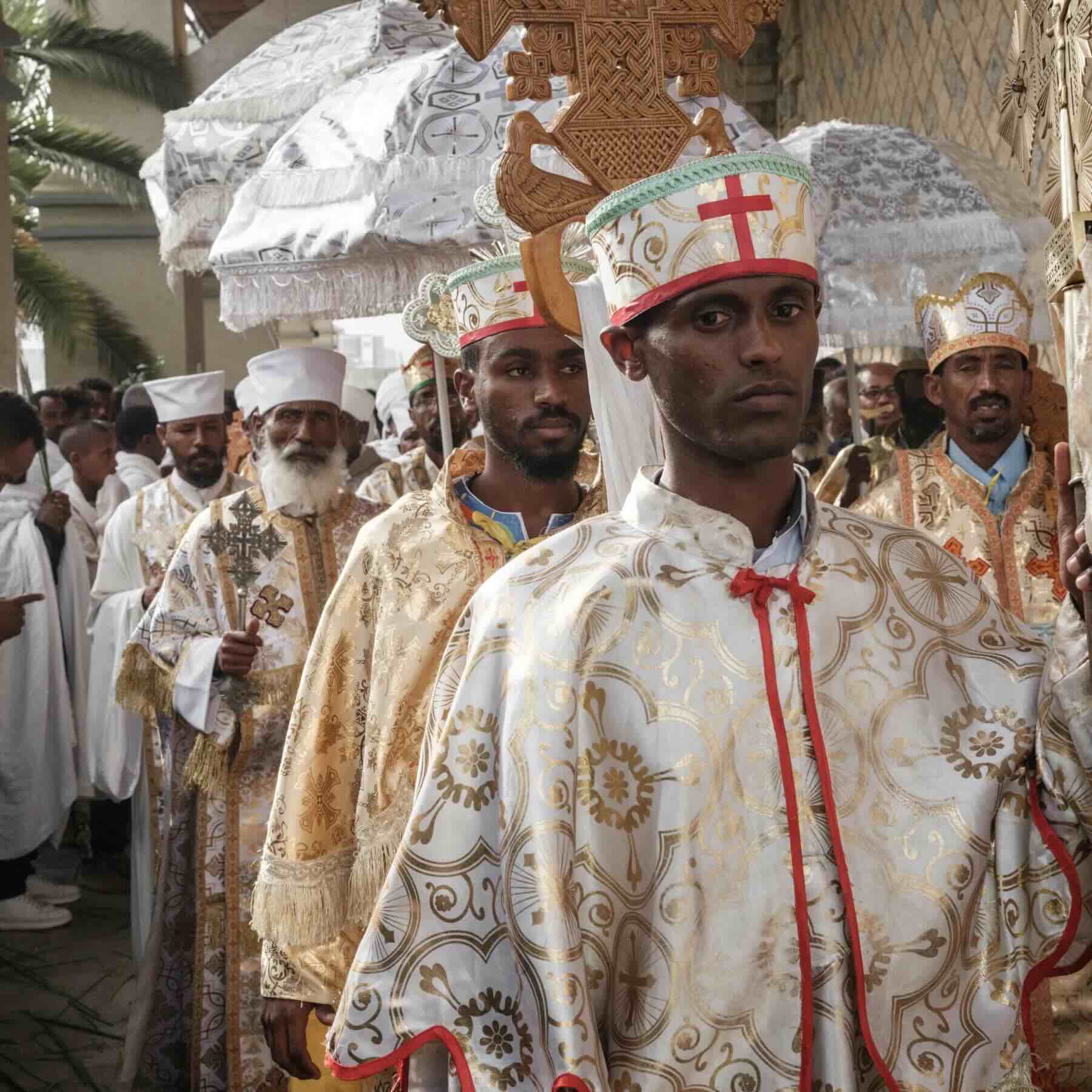
The Ethiopian church retained practices that trace back to its roots in Jewish and early Semitic Christianity in ways that no European tradition preserved. It observes both Saturday and Sunday as holy days, maintaining the Jewish Sabbath alongside the Christian one. It practises infant circumcision. Its priests and deacons conduct the liturgy in Ge'ez, an ancient Semitic language that is no longer spoken in daily life but has been the language of Ethiopian Christian worship for over sixteen centuries. The experience of attending an Ethiopian Orthodox service is unlike any other Christian worship in the world: chanting, drums, the smell of incense, priests in elaborate vestments, the congregation separated by a curtain from the holiest part of the church where the tabot, a replica of the Ark of the Covenant, is kept.
The church's biblical canon is the largest of any Christian denomination. Where the Protestant Bible contains 66 books and the Catholic Bible 73, the Ethiopian Orthodox canon runs to 81, including texts like the Book of Enoch and the Book of Jubilees that were excluded from every other major Christian tradition. These texts survived in their complete form almost exclusively because Ethiopian monks preserved them.
Those monks matter enormously to the story. Ethiopian Orthodox monasticism produced some of the most significant centres of learning in the medieval world, places where manuscripts were copied, preserved, and studied across centuries. The church forests that surround Ethiopian churches are themselves a product of this tradition: as deforestation stripped most of the country of its original vegetation, the land around churches remained protected by religious custom, creating islands of biodiversity that now hold a significant proportion of Ethiopia's remaining native forest. An institution that preserved both ancient texts and ancient trees is doing something more than religion.
The church also claims to hold the Ark of the Covenant itself, housed in a chapel in the city of Aksum, tended by a single guardian monk who is appointed for life and never leaves the chapel grounds. The claim cannot be verified. But the seriousness with which it is held, and the elaborate ritual structure built around it, says something about the depth of the institution's relationship with the traditions it carries.
The Ethiopian Orthodox Tewahedo Church currently accounts for roughly 44 percent of Ethiopia's population, somewhere between 45 and 50 million people, with significant diaspora communities in the United States, the United Kingdom, Canada, Australia, and Israel. It is not a historical artefact. It is a living institution, one that shapes daily life in Ethiopia more thoroughly than most religious bodies shape the societies they inhabit anywhere in the world.
The liturgical calendar governs the social calendar. Ethiopian Orthodox Christians fast for more days of the year than almost any other Christian community, with over 200 fasting days observed by the devout. Timkat, the celebration of Epiphany, involves processions through the streets with the tabot carried on priests' heads, singing, crowds gathering before dawn. Meskel, the feast marking the Finding of the True Cross, fills public squares with bonfire celebrations. These are not private religious observances. They are public cultural events that shape the texture of the year.
There is a young Ethiopian, interviewed in a documentary about the church, who was asked why so many of his generation were not leaving the faith as young people in the West increasingly have. His answer was simple: we were never colonised, and so we love and respect our tradition. That sentence requires some qualification. Italy did occupy Ethiopia between 1936 and 1941, damaging churches and executing clergy in the process. But the occupation was resisted, eventually reversed, and crucially, it did not dismantle the church's theological authority, its language, or its institutional structure in the way that colonial Christianity did elsewhere across Africa. The church arrived at the present with its core identity largely intact.
The church has faced its own pressures from within. Under the Marxist military junta that came to power in 1974, the patriarch was executed, the church was disestablished, and its extensive landholdings were seized. It has navigated internal divisions and the politics of a complex, multi-ethnic nation. It has had to respond to modernisation, urbanisation, and the growing influence of evangelical Christianity across Ethiopia. None of these pressures have dissolved it.
What the Ethiopian Orthodox Tewahedo Church represents, at its most essential, is a proof of what African institutions can become when given centuries to develop without being fundamentally reshaped from the outside. A theology that resolved its own questions. A language that has carried worship across sixteen centuries. A canon that preserved texts the rest of the world lost. A community that remained.
The rest of global Christianity spent much of the last five hundred years being carried across the world by empire. Ethiopia's church stayed where it was and went deeper. The results are still visible, and still alive.